First night with the mono camera
The night of 4 to 5 November: a friend's cooled mono camera, filter wheel and coma corrector fitted to the 150P in the afternoon, and that night its first darks, first focus, quicker plate solves, the Pacman and Triangulum, and a string of fixes so the camera stays cold all night.
Shot 4 to 5 November, between 19:50 and 05:10, a back garden in Northern Ireland.
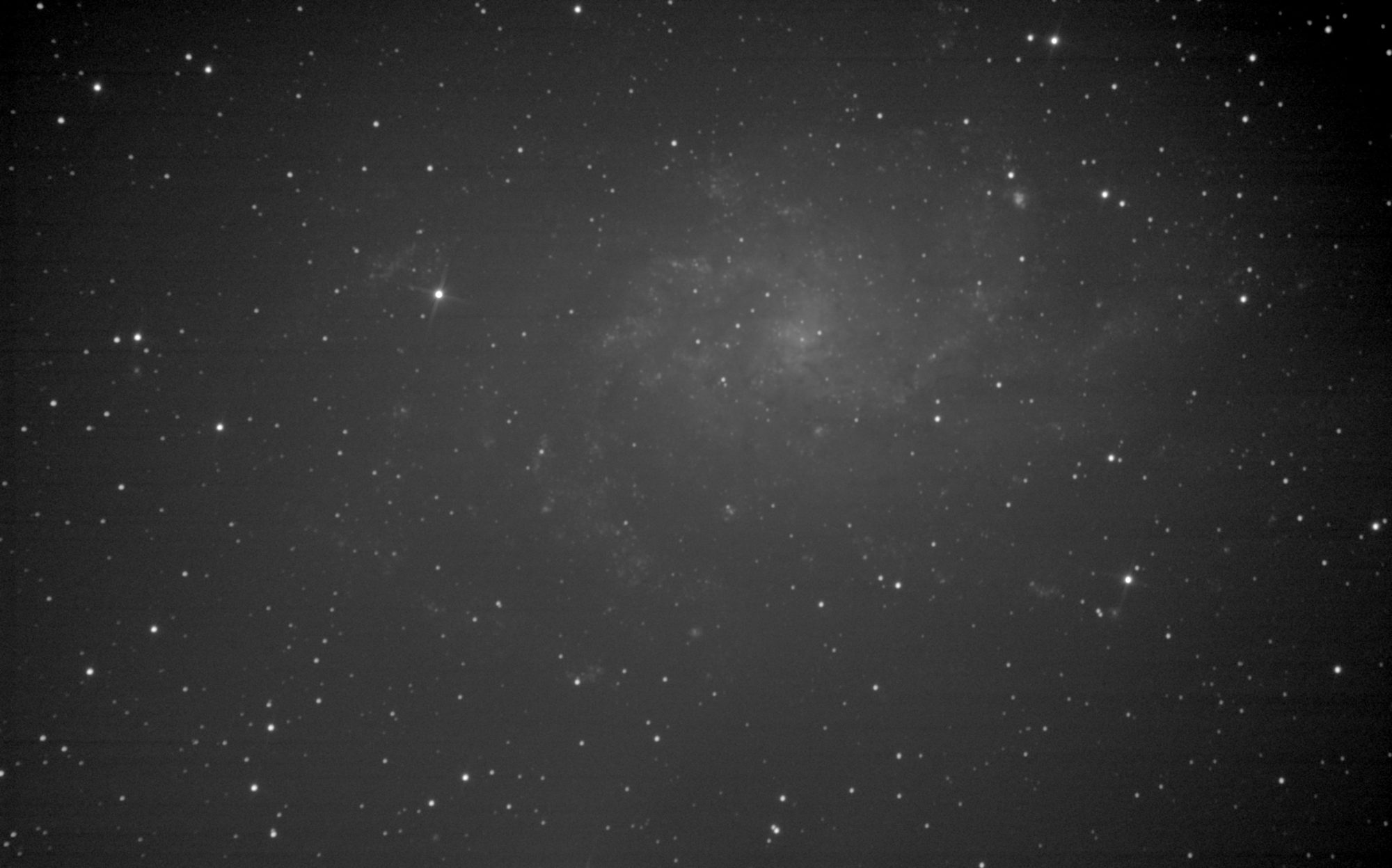
The Triangulum Galaxy (M33) in luminance, about 40 minutes of 16-second frames from the new camera.
The new camera
In the afternoon a friend fitted his mono rig to my 150P: an Altair Hypercam 183M PRO TEC cooled camera, a Starlight Xpress seven-slot filter wheel (luminance, red, green, blue, hydrogen-alpha, sulphur and oxygen), a coma corrector, and the primary mirror moved about 20 mm nearer the focuser so it all comes to focus. On the bench, with the cap on, every frame arrived at every speed, which the old colour camera never managed.
The night
Focus by hand on Enif came out at an HFR of 2.0, inside the drawtube’s travel, so the mirror move was enough. Plate solves started out taking about two minutes each. A blurring step in the code was the cause, and with it gone they take a fifth of a second.
The camera’s first darks were taken at -5 °C, cooling slowly as I’d been told to. Then came the Pacman Nebula in luminance, until cloud stopped it after 6 minutes, and Triangulum: about 40 minutes of luminance, sharper than the old camera. Red, green and blue were taken too, but a drift between the filter blocks left each one covering only part of the frame, so the colour picture needs doing again.
Most of the night’s work was keeping the camera cold. Every small field shift and every filter change was closing the camera, so the cooler stopped and the sensor warmed by several degrees. By the end the camera stayed open, and cold, for a whole session. Cloud took M81 and M82 and M106 later in the night.