A new corner of the garden, and the first night I slept through
A fight with focus, polar alignment with a broken bolt, the Andromeda patrol, a stalling motor that left the telescope staring at the house, and then the first night the telescope carried on by itself while I slept: Triangulum, M37, the Crab Nebula and Bode's Galaxy.
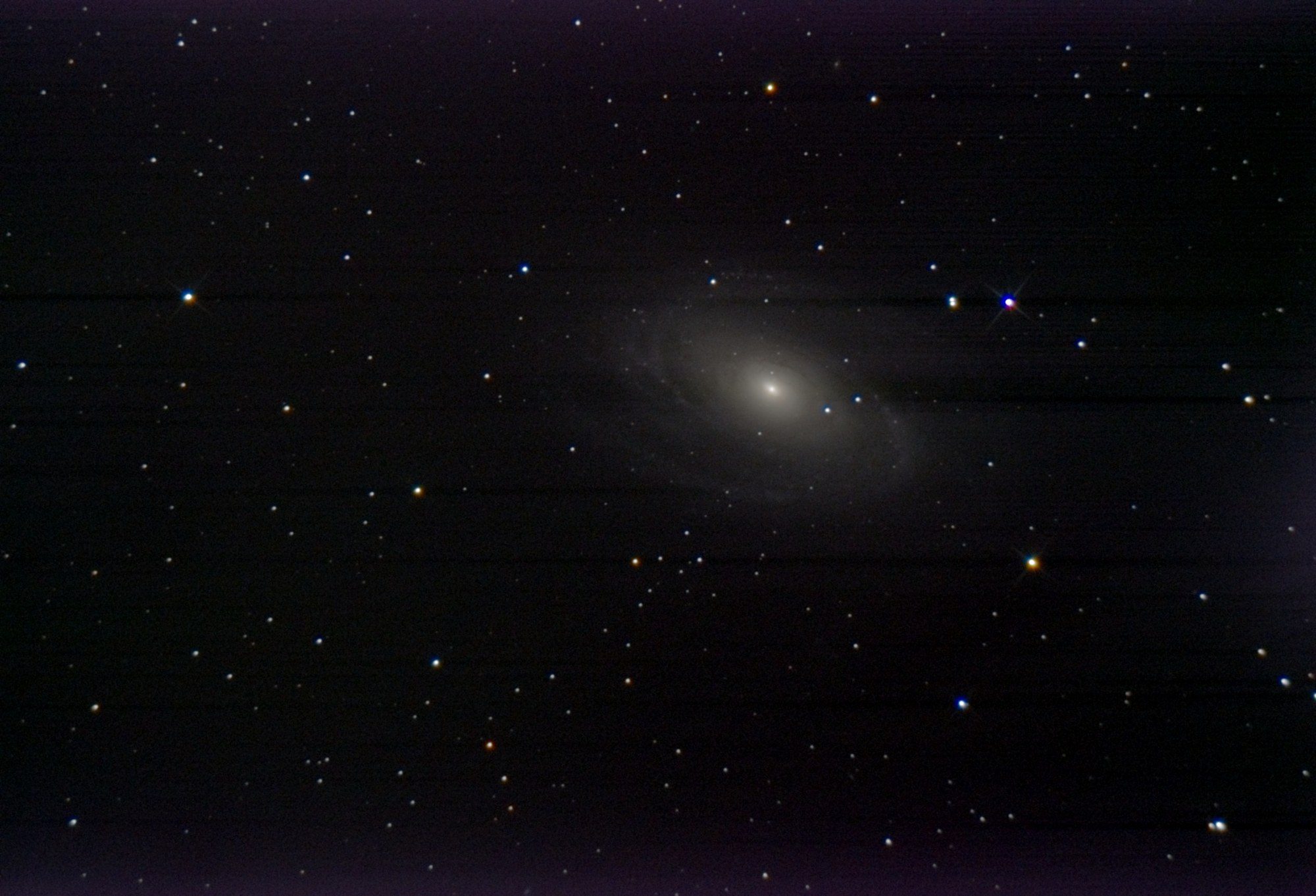
Bode’s Galaxy, M81, twelve million light years away. 136 frames of 16 seconds, taken between 4 and half 5 in the morning while I was asleep. Every frame it took was good enough to keep.
Sunday 18 October. Clear all night, the Moon setting at about eleven. A back garden in Northern Ireland.
A new spot
Tonight the telescope went to a different corner of the garden, to get round the house that blocks the whole west from the usual spot. Before dark I took the motor focuser off to tighten its nuts, took the camera off and cleaned the speck off the sensor, and put it back in a USB port it had never used. The sensor clean worked: the dark blotch in the middle of every picture has gone.
Focus took the evening
Taking the camera off and on moved focus a long way, and getting it back took most of the evening. The motor slipped going outwards until I loosened a nut. Claude’s step-by-step focusing was fooled by star sizes jumping about from frame to frame near focus, and a faster version with bigger steps ran five turns the wrong way. In the end I focused by hand with Claude reading the star sizes out, and got them to 2.15, sharper than usual.
Claude has since rewritten the focusing to sweep right through focus in nine steps from one side, fit a curve to the readings and move once to the bottom of it. Its first try on the sky was spoiled by the coupling slipping, so it still has to prove itself.
Polar alignment
By eye I had the mount 3.6° out. Turning the tripod brought it to 0.9°, and a bolt turn to 0.8°. One of the bolts is broken, so I left it there. That’s good enough for short exposures.
Andromeda, and a camera that forgot its settings
The Andromeda patrol started at about half nine and straight away threw out frames for a “brightened sky” on a clear night. The new USB port had reset the camera’s black level to zero, so the sky read as nothing and the software took that as cloud. Once the level was set back and a new calibration frame taken with the cap on, every frame was kept.
While it ran, we tested what the house lights do from here. The kitchen light brightens the sky by 7%, and the bathroom and utility room lights make no difference at all.
Panel 4 threw up two possible new stars. A second look, with the telescope shifted slightly, showed nothing at either spot, and they were leftovers from a striped reference picture. Panel 6 caught a streak that matched none of the 16,755 satellites up tonight. It points back almost to the radiant of the epsilon Geminid meteor shower, which peaked tonight, so it was most likely a meteor.
The telescope looking at the house
Just after eleven the mount started clicking every twenty seconds and the stars trailed. The handset said it was tracking perfectly, but the RA motor was turning at half speed. A power cycle fixed it, as it did on 6 October. An hour later it happened again in the middle of a long GoTo, and I found the telescope lying flat and pointing at the house wall. Another power cycle. The motor needs looking at in daylight.
Triangulum
After midnight the telescope moved to the Triangulum Galaxy and took it in three runs, on both sides of the meridian, swinging over the pole in between.
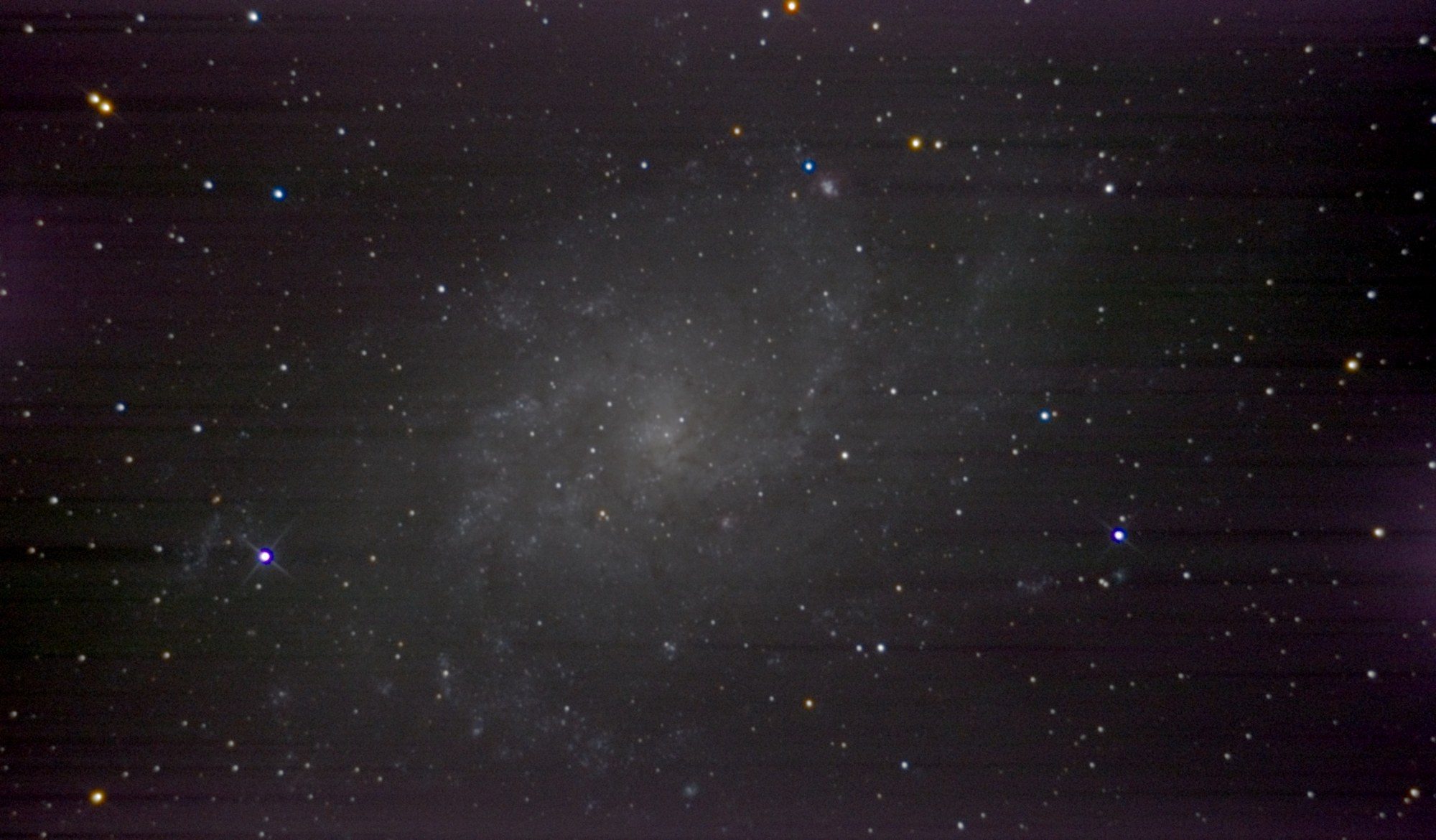
The Triangulum Galaxy, M33, from three runs stacked together: 88 frames of 32 seconds, 47 minutes in all. The spiral arms show far better than on 15 October. The pink knot above the core is NGC 604, a huge cloud where stars are forming.
Andromeda from every night
While it was imaging, Claude wrote a program that takes every frame of Andromeda from every night so far, places each night’s picture by its stars and blends them into one mosaic. It adds each new night by itself after every patrol.
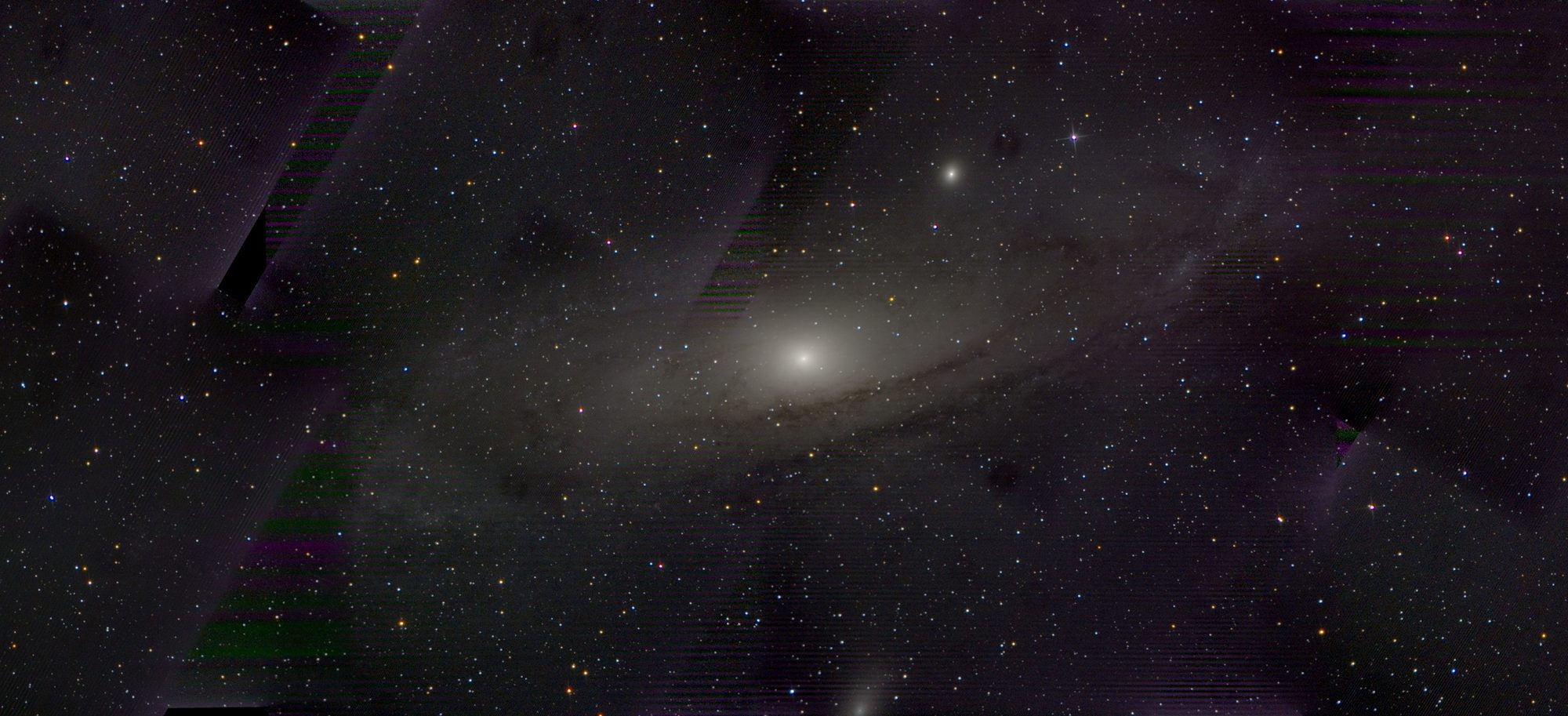
The Andromeda Galaxy from every night’s panels so far: 18 sessions joined into one picture. The joins and stripes still show at the edges, where only one of the striped nights reached.
Asleep
At quarter past one I went to bed and told Claude to keep it going as long as the mount and camera behaved, and to message me on my phone if they didn’t. It had rules: no GoTo within half an hour of the meridian, and stop and leave the mount if a picture didn’t line up or the frames went bad.
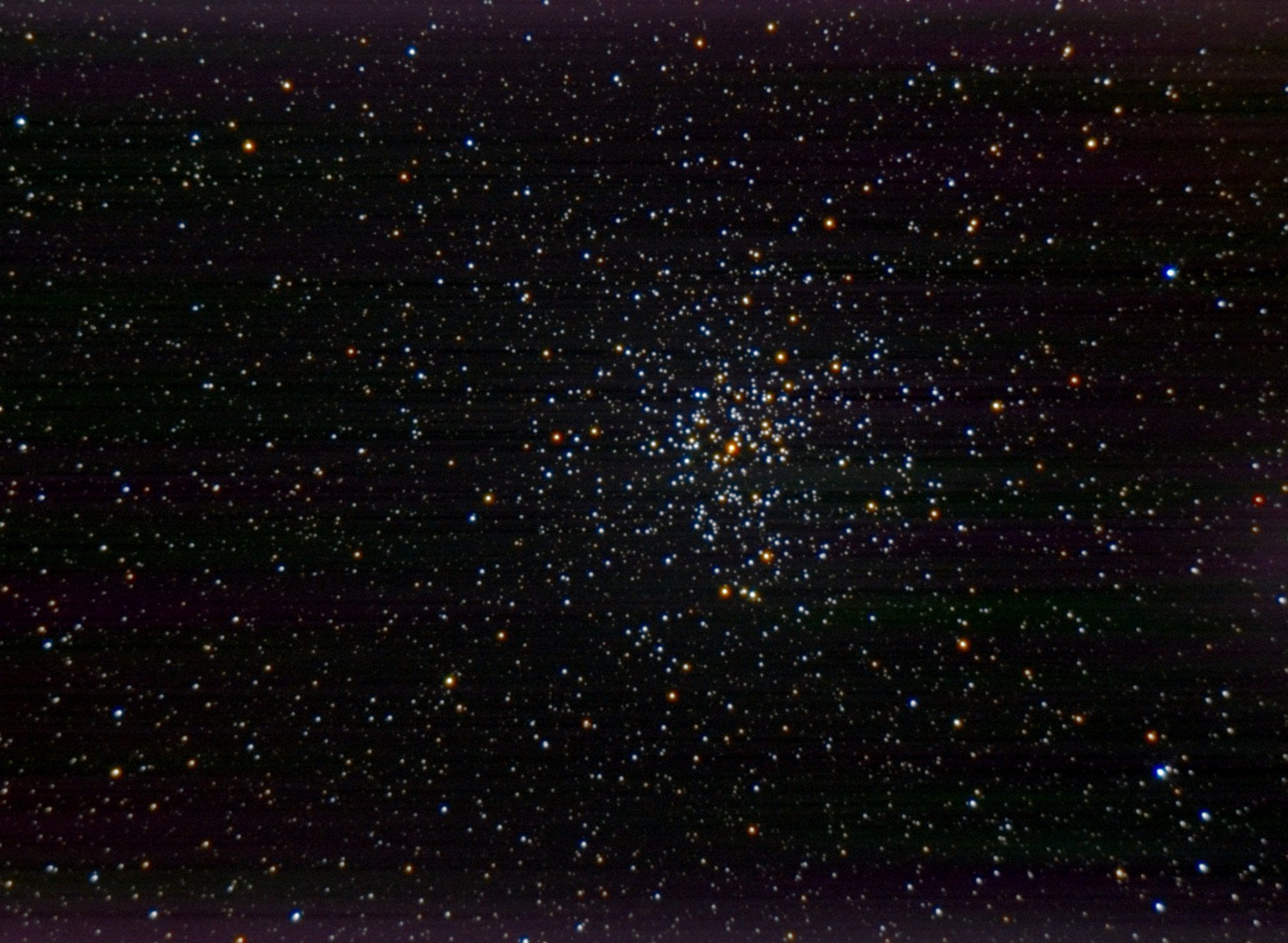
M37, an open cluster in Auriga, about 4,500 light years away. All 140 frames of 16 seconds were kept, and the best 119 are stacked here. The camera reads faint stripes into every frame, and part of them is the same each time, so they built up as green bands in every stack from tonight. The software now takes them out of each frame before stacking. The thin dark lines that are left are what it can’t reach yet.
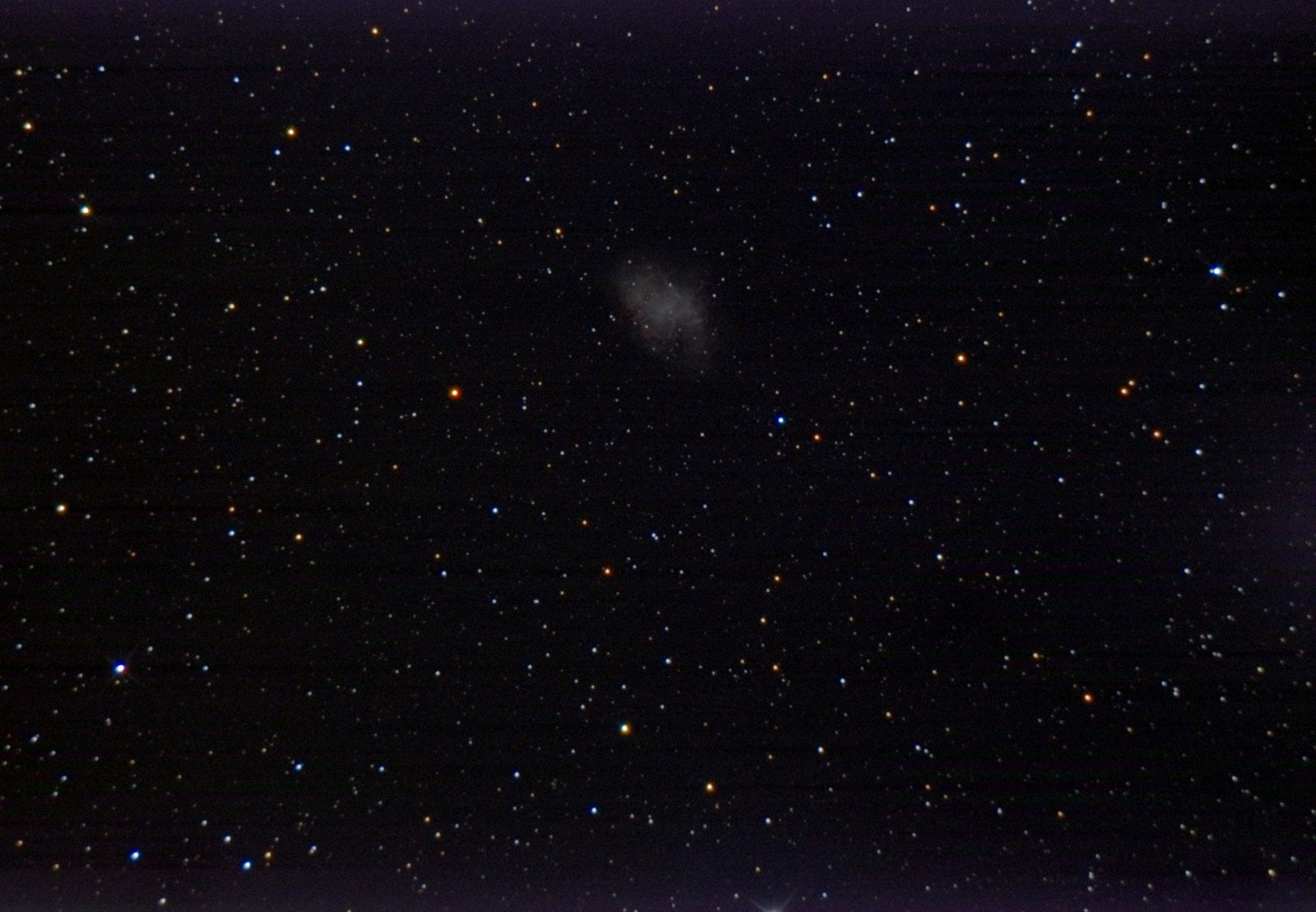
The Crab Nebula, M1, the remains of a star that exploded in 1054. Only 33 frames, because the camera hung at ten to four.
The camera hung during the Crab Nebula. It came back after a restart, but the run had stopped. The next target, the Orion Nebula, was behind something from this spot, so it went on to Bode’s Galaxy and took all 160 frames, though the camera was missing about one exposure in three and having to take it again. At quarter to six the mount went home by itself, and a message on my phone said the night was done.
It’s the first time the telescope has run on its own while I slept, and it came back with four targets.