The telescope goes live, and the software finds a comet on its own
A night spent winning back focus with a motor that only works downhill, all eight Andromeda panels in an hour and a half, the first live stream on Twitch, a first try at an exoplanet transit while I slept, and in the morning a sungrazing comet the software had found by itself.
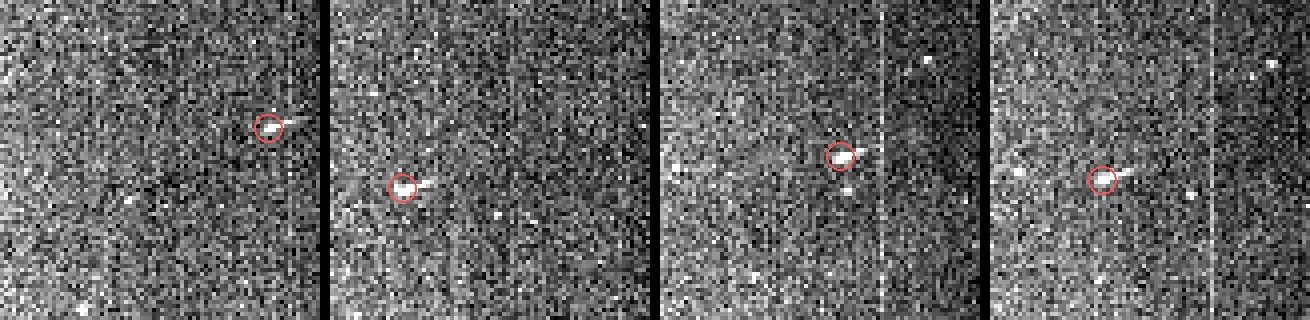
A Kreutz sungrazing comet falling towards the Sun on 19 October, in pictures from the GOES-19 weather satellite’s coronagraph. The software found it by itself in 74 pictures, followed it for seven hours across a gap in the pictures, and matched it to a report of a known comet. Not a new one, but nobody told it where to look.
Monday 19 October. Clear spells between clouds from half nine, clearer after midnight, the Moon setting at half twelve. A back garden in Northern Ireland.
The camera on the bench
The camera had been playing up on the cold nights, with stripes across every frame and long exposures going missing, so it spent the afternoon indoors. Its own diagnostic file says it was made in June 2017 and is still on its first firmware, with no memory of its own to hold a frame. Every row goes straight down the USB lead as it is read. That went to the maker in a support ticket.
Warm, with the cap on, it behaved: 116 dark frames over an hour and a half, every one arrived, and the stripes were at their ordinary level. The darks also showed the sensor warming up, so they now double as the camera’s thermometer. The cold, damp test still has to be done outside.
Measuring the motor with a cocktail stick
The motor focuser had never been measured properly, so I built a rig on a stool. A printed protractor fitted round the motor, a cocktail stick on its shaft blacked with a Sharpie, and my phone looking straight down as a webcam. Claude turned the motor and read the stick’s angle off the phone’s pictures. After three spoiled runs it got a clean one: 0.088° a step, about 30 steps of slack, and it comes back to the same place every time.
Focus, downhill only
Out at the telescope the stars were enormous doughnuts. Focus had moved a long way with the camera off on the bench, and the motor focusing couldn’t recognise doughnuts as stars at all, so it saw nothing. It also turned out the motor couldn’t push the drawtube uphill against the camera’s weight. It slipped, losing up to a quarter of a turn every time it changed direction.
What did work was letting gravity help. Pointing at Andromeda the camera’s weight pulls the drawtube in, so I set it a little out by hand, and Claude brought it in 32 steps at a time, measuring the stars after each: 9.0, 4.5, 2.6, 1.8, then 1.58. That’s the sharpest this telescope has ever measured; my usual best is 2.28. Within a few minutes Claude had turned it into a command, along with two other fixes, all written, tested and pushed in under nine minutes. Polar alignment came out 0.6° off, and the azimuth bolts brought it to 0.1° east-west.
Andromeda in an hour and a half
The plan was the Andromeda nova patrol, then all eight panels of the Andromeda mosaic, then a transit. The nova patrol’s 114 frames were all kept, but its stack wouldn’t match the star map, so it never got as far as a search. The panels went about 30% faster than last time, with under two minutes between them, and all eight were done by twenty to two. Each reached about magnitude 16.7.
Panel 8 threw up four possible new stars and panel 6 one. The second look at panel 8 found none of the four again, and two new spots in the same small patch pointed to a fault in the reference picture there, so it was a false alarm. Panel 6’s second look waits for the next clear night. A panel 4 candidate from the 18th seemed to come back too, but measured on each night’s picture on its own, with no reference involved, there was nothing there: the same flaw in the reference again.
Live on Twitch
While the panels ran, Claude built the live stream. I made a channel and handed over the key, and at twenty past two the telescope went live on Twitch, showing the picture building up frame by frame. The stream info still said I was playing Plants vs. Zombies on a PS5, so Claude fixed the title and category, and registered a small app so the stream can set its own title for each target. A spam bot turned up in the chat within twenty minutes, selling “AI viewers”. Then some real viewers turned up too, and Claude gave the stream a proper look while it was on air: the picture filling most of the screen, what the object is, the night’s figures, and short explainers every few minutes.
A planet’s shadow
From quarter to two the telescope watched WASP-12, a star with a giant planet so close it goes round in just over a day. When the planet crosses the star the light dips by about 1.5%. I went to bed at ten past three with the camera and mount behaving, and it ran on, keeping 973 frames of 4 seconds through the start and middle of the transit.
Cloud came at ten to five, and the camera began hanging. The first hang crashed the run and the alarm woke me, every light in the house going red. Claude restarted it without moving the mount, told me to go back to sleep, and brought the camera back three more times before cloud took the end of the transit at half five. The night stopped there with the mount still tracking, and it was still tracking when I came down in the morning. From now on the night ends with the mount parked and a message on my phone saying so.
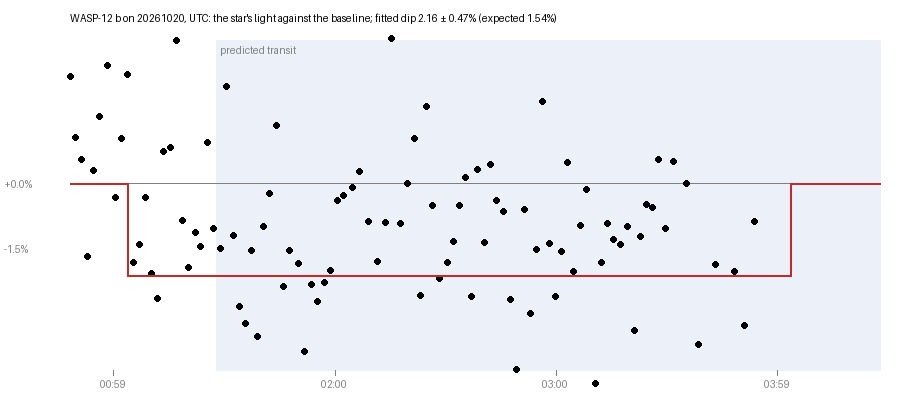
WASP-12’s light against its level before the transit, one point for every 10 frames. Shaded: when the transit was predicted. Red: the dip that fits best.
The star does look about 2% fainter after the first forty minutes, about what the planet should do. But it isn’t a detection. With the end of the transit lost to cloud there’s no baseline after it, and a slow drift through the night would look the same. The points are also too scattered: about 14 thousandths of a magnitude each, against a dip of about 16.
Measuring the same frames 288 different ways showed why. Each 4-second frame was too short for a star this faint against the noise round it, the comparison stars mattered more than anything else, and the star’s light drifted steadily as it rose. There were no flat frames either. Next time it will have flats, much longer exposures, a careful choice of comparison stars, the star held on the same pixels all night, and an hour of baseline either side.
A comet
In the morning there was a message on my phone: the comet hunt, which searches the weather satellite’s pictures round the Sun every six hours, had three tracks heading for the Sun. Two were the same object split by a 45-minute gap in the pictures. Its position and speed matched a report already on the Sungrazer Project’s list of a known Kreutz comet, to within two pixels. The third was flicker at the edge of the disc that blocks out the Sun. SOHO’s camera showed a track heading in over the same hours as well.
It isn’t a new comet, but it’s the first time the software has found a real one on its own. By mid-morning it had learned from it: it now joins a track across a gap, gives positions the way the project measures them, checks each find against the project’s reports, and ignores weak flicker at the disc’s edge. Now it sends two messages: what it found, then, once checked against the planets, bright stars and the project’s reports, what each one turned out to be. The stream will show a known comet it recovers too, as a short card about the comet hunt.