A colour Moon between the clouds
A late gap in the cloud for a colour "mineral Moon": 2,500 frames of the 80%-lit Moon, a crash and its fix, a stream that finally showed what the telescope saw, and M34 before the cloud came back.
29 to 30 October. A back garden in Northern Ireland.
A gap the forecast didn’t have
The forecast said cloud with maybe an hour clear at two in the morning. At half eleven it was clearing, and the wind was lighter than forecast. The Moon was 80% lit, which costs the nova patrols about half a magnitude, so instead of a grey Moon everyone has, I went for a colour one. The 183C is a colour camera. Stack enough frames and push the saturation, and the Moon’s real colours come out: the titanium-rich seas bluish, the iron-rich ones brown. A Moon near full is the right phase for it, since flat light shows what the surface is made of rather than its shadows.
Focus, then finding the Moon
Focusing went well. The first try ran into a cloud by Saturn, so Claude moved to Capella. Two walk-ins later, the second from the drawtube set a touch out by hand, the stars were down to HFR 1.5, the best yet against a usual 2.3.
Finding the Moon was harder. I’d only set the handset, with no alignment, and the pointing turned out to be more than two degrees out. Cloud kept covering everything we could plate-solve on. A gap over Capella finally gave a solve, but the Moon still wasn’t in the frame. In the next gap Claude stepped round it and found it 40 arcminutes to the west, sharp in clear sky.
2,500 frames, and a crash
The first run took two bursts of 500 frames, then the laptop went crashy and I rebooted it. The cause was in the camera code: every video frame, 24 MB each, was being kept in memory instead of freed. The run had grown to 18.5 GB when the system killed it. The video already written survived. Claude fixed the leak and the reader that had to cope with the cut-off file, and the next two runs stayed flat at about 650 MB. By the end there were 2,513 frames, all centred, the later ones in clear sky at 7 ms. The finished colour Moon has its own entry: The mineral Moon.
The stream
Nothing was showing on YouTube or Twitch, and it took a while to get straight why. YouTube was receiving the video but stuck on “Preparing stream” until a new Dual stream setting was switched off. The stream’s picture stretch, built for stars on a dark sky, turned the Moon black. And it kept putting up a “Tonight complete” card with another night’s figures.
By the end the Moon was live on both, with the usual panel beside it. A live view now keeps it on air between runs and moves the mount back as the Moon drifts against the stars. The cards that covered the picture are gone, and the stream stops when the night does. What the scope sees is what goes out.
M34, before the cloud
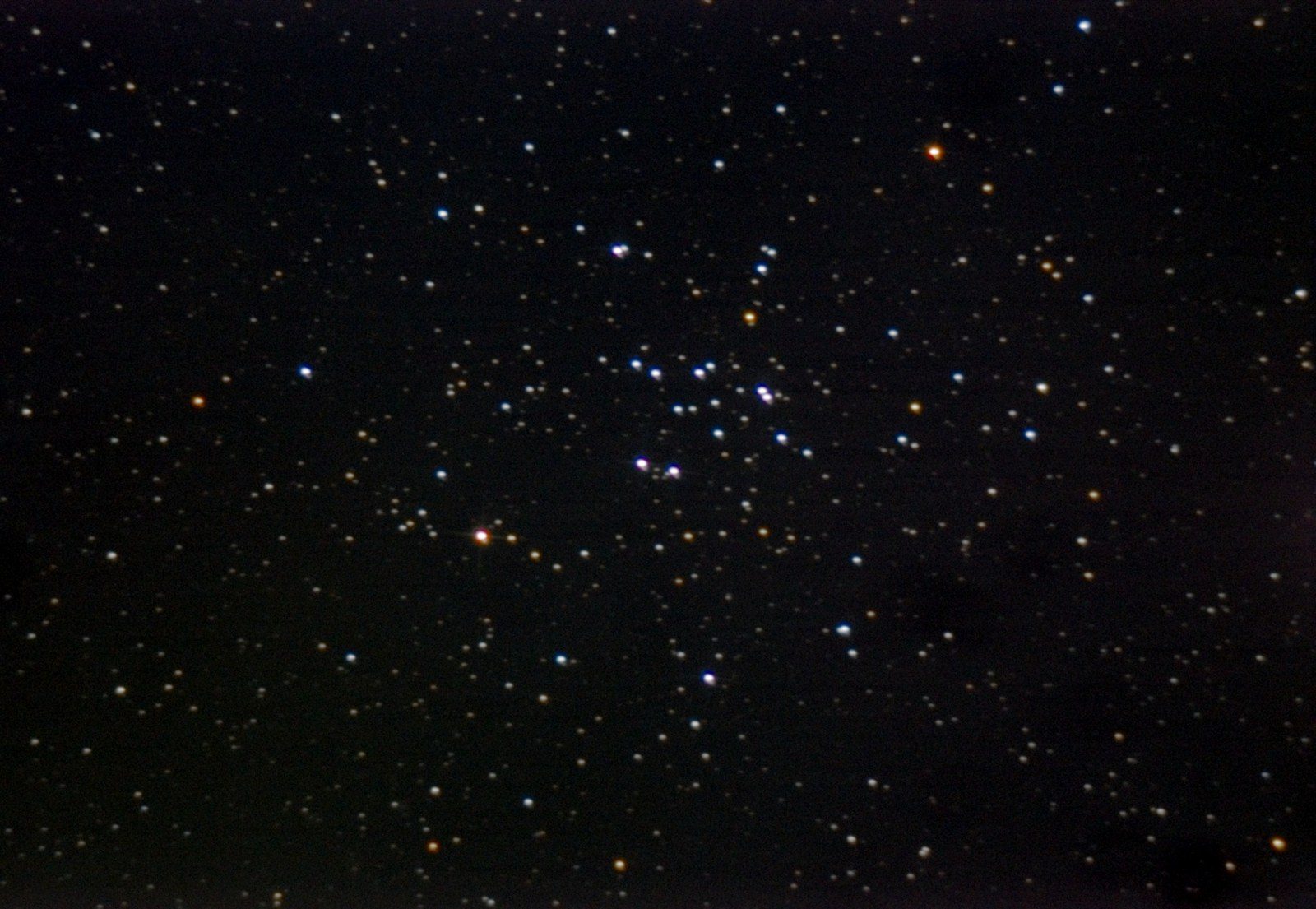
At three, M34 was clear. A GoTo with a plate solve put it in the middle, and twelve 16-second frames got through before the cloud came back.
The camera
After the night, with the camera still outside, a test at its fastest readout kept 8 of 8 long frames. The air was about 11 °C with 78% humidity: mild, not cold. So the camera goes back to its fastest speed until the old lost-frame fault comes back. Sunday is forecast clear and close to freezing by four. I’ll run the same test in the house before we start, so if it starts misbehaving at low temperatures, we’ll have a strong suspect.
One more thing turned up: the laptop’s 1 TB hard disk had a 700 GB partition sitting empty while the SSD filled up. The Moon videos live there now.
The night on the Fitbit
From midnight to packing up at half three: 1,610 steps (1.1 km) back and forth to the scope, 68 minutes of light activity and 73 sitting, a heart rate averaging 97 and peaking at 126, and about 139 active kcal.