Project · Released v0.2.1
telescopeyoke
Makes an ordinary Sky-Watcher SynScan telescope smarter, by measuring the things that normally have to be set up perfectly by hand.
- Python
- astropy
- ASTAP plate solving
- INDI
- Arduino
- MCP
- 107′ → 6′ → 1′
- M27 centred in three corrections on the first night, from about ten degrees out
- 3.3° → 0.1°
- polar alignment over six rounds, 13 October 2026
- 641
- automated tests, on Python 3.11 to 3.14, Ubuntu and Windows
On 3 October 2026 I put a laptop outside beside a new motorised mount and told Claude it was hooked up to a telescope. telescopeyoke is what came out of that night and the two weeks since.
The problem
The kit most people start with, a Sky-Watcher telescope on a SynScan GoTo mount, assumes it has been set up perfectly: the home position exact, the polar axis on the pole, the focus spot on. I couldn’t do any of that on the first night, and I’m doing it in a back garden with a house in the way.
So telescopeyoke is built around one idea: measure the imperfections of modest equipment instead of pretending they are not there. Each one is measured, and then corrected or planned around. It runs on a laptop left beside the telescope, and I watch from indoors.
What it does
- Centres every GoTo by plate solving. It photographs the sky, works out where the telescope really ended up, corrects, and repeats until the target is in the middle.
- Measures the polar alignment from three plate solves, and says which bolt to turn and roughly how far, with a drawing of it.
- Focuses by ear. A click for every frame and a tone that rises as the stars sharpen, so my eyes stay on the focuser. Or the £30 motor focuser does it by itself.
- Ranks targets for my actual sky: altitude, the Moon, light pollution, and the skyline, measured from a phone panorama.
- Plans the night with a GO, MARGINAL or NO-GO verdict from cloud, rain, wind, dew and seeing.
- Captures and stacks, keeping every raw frame, so a better method next month can remake last night’s picture.
- Notices when the mount says it moved and didn’t.
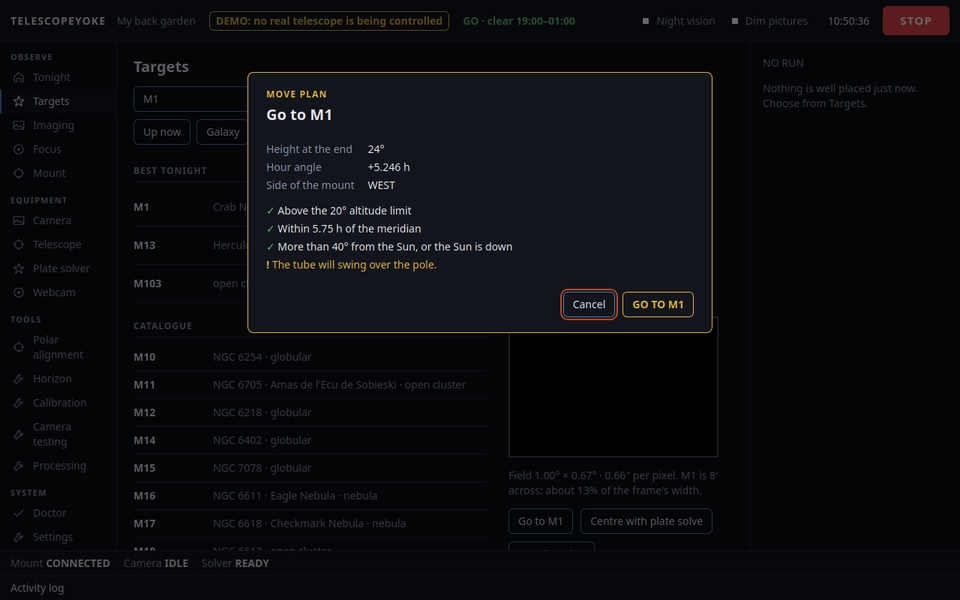
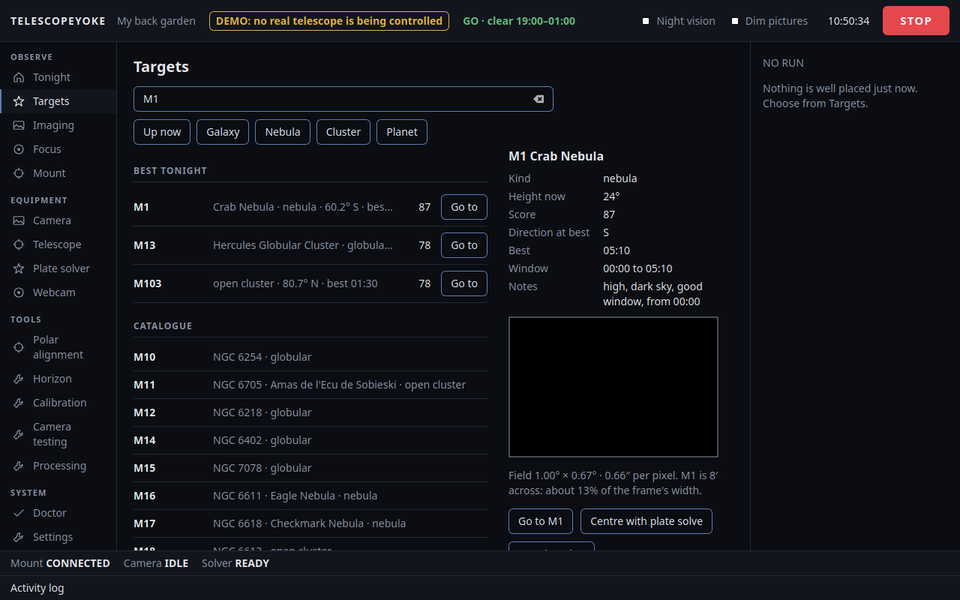
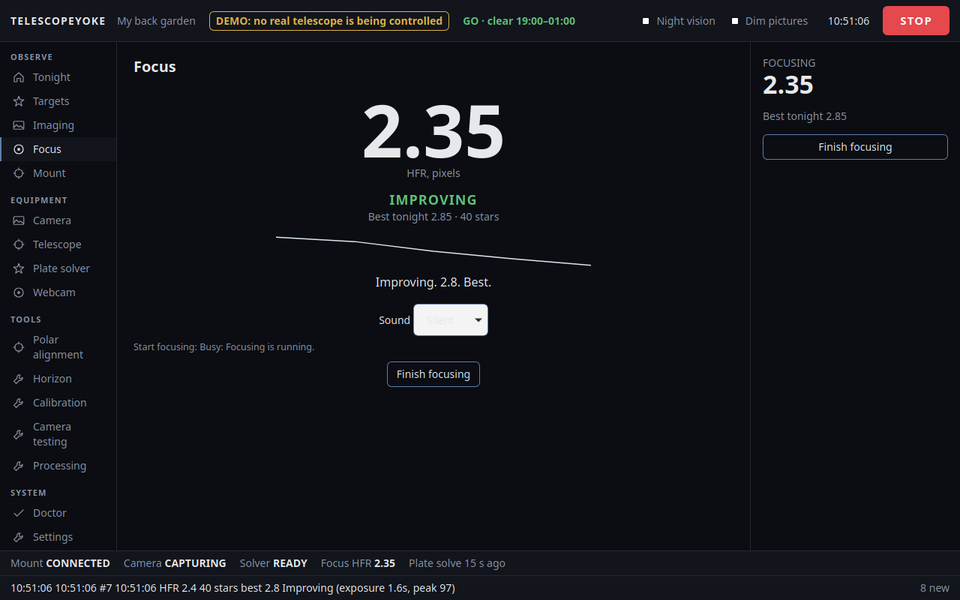
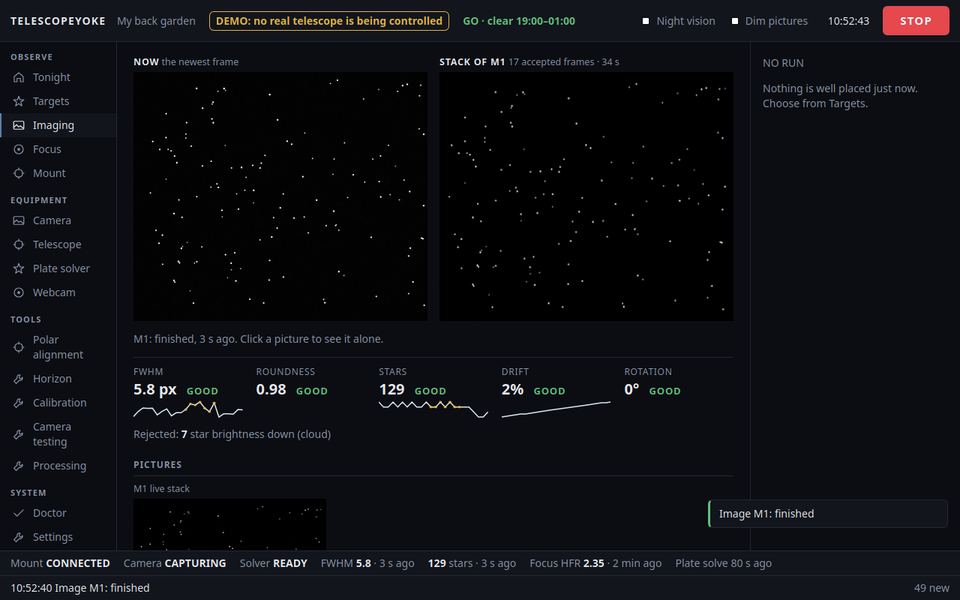
All 4 are the built-in demo, on the simulated rig; the video above opens on its Tonight screen.
How it’s built
Python, about 34,500 lines of it, with 641 automated tests that run on every push, on Python 3.11 to 3.14, on Ubuntu and on Windows. Plate solving is ASTAP. The camera goes through INDI on Linux and Altair’s SDK on Windows. The motor focuser is an Arduino Nano driving a small stepper motor, and its firmware is in the repository.
Three decisions worth explaining:
- A pretend rig, not mocked-up screens. A complete simulated mount, camera, sky, focuser and cloud is built in, and the real centring, focusing and stacking code runs on it. Every screenshot on this page comes from that demo.
- Claude drives it. The repository has an agent interface: a
tycommand that answers in JSON, and a read-only MCP server. Claude runs the telescope from night to night. It does the sums and I do the looking. - Trust nothing that hasn’t been seen. On 6 October the motors stopped without a sound while the handset went on reporting every move as made, and a survey stared at one tree for half an hour. Now a GoTo, a polar measurement or a survey whose pictures don’t change stops with “the mount is not moving”.
Evidence
A real run from the first night. The home position had been set by eye and was about ten degrees out:
$ ./mount.py goto M27 --solve
M27 Dumbbell Nebula: altitude 57°, hour angle +0.36 h (west: the tube will swing over the pole)
  off by -107.0' in hour angle, +94.4' in Dec
  off by -6.2' in hour angle, -11.4' in Dec
  off by +1.0' in hour angle, -1.8' in Dec
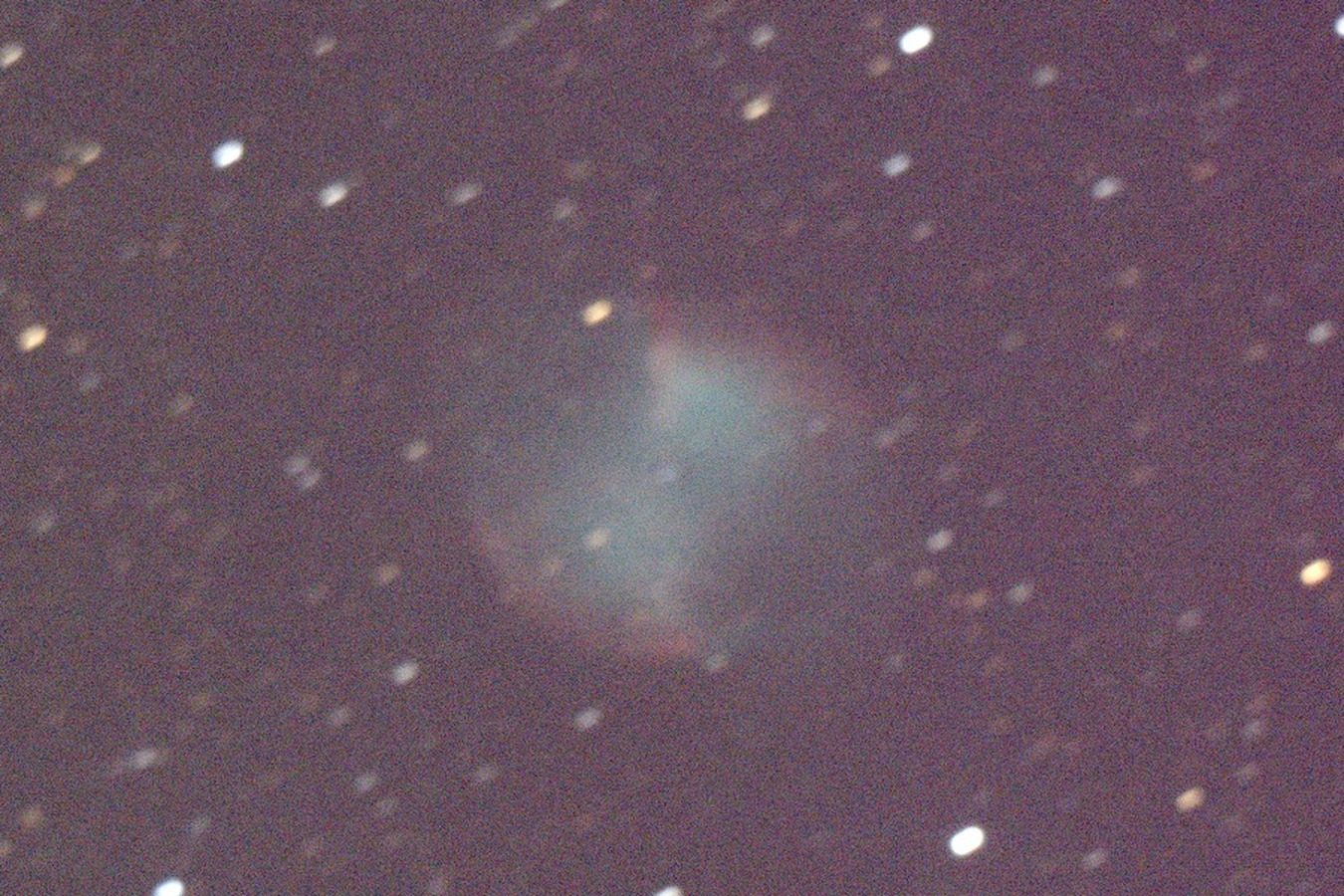
centredAnd the Dumbbell Nebula from that night: 48 two-second exposures, with the mount polar aligned by eye.
What’s proven, and what isn’t
“Under real stars” means my EQ3 Pro, 150P and a borrowed Hypercam 183C, at night. Everything is also run on the simulated rig and in the tests. The full record, night by night, is docs/validation.md in the repository.
| Feature | Under real stars | Detail |
|---|---|---|
| GoTo centred by plate solving | Proven | To about an arcminute, from 10° out |
| Polar alignment from three plate solves | Proven | 3.3° to 0.1° over six rounds; how well it repeats is not yet known |
| Focusing: measuring the stars | Proven | The reading fell from 11 to about 2 as focus was reached |
| Motor focuser | Proven | Focused the 150P to HFR 2.47 on 15 October 2026 |
| Imaging and stacking | Partly | Real runs of 48 and 207 frames; the newest fixes not yet rerun |
| Drift model and Dec correction | Partly | Only an earlier, cruder version has run under real stars |
| Finding Polaris by day | Partly | Searched three times on the real mount; Polaris not found yet |
| Discovery: novae and other new objects | Partly | Run on real M31 stacks with planted fakes; no find of our own yet |
| Focusing by ear: click, tone and levels | Not yet | Run only on made-up stars |
| Driving a mount on Windows | Not yet | Camera frames taken indoors; no mount driven yet |
Follow it
Every night it has been out is in the astrophotography diary. You can try it without a telescope: the 0.2.1 release opens on the pretend rig.