Testing the free tools on my own data
GraXpert, Siril, Cosmic Clarity, DeepSNR, StarNet and Dark Star, measured on my own stacks: what each does well, what it costs, and which ones TelescopeYoke will use for its pictures.
- telescopeyoke
- v0.2.1, the latest release on this date
Started 23 November, and updated as each test finishes.
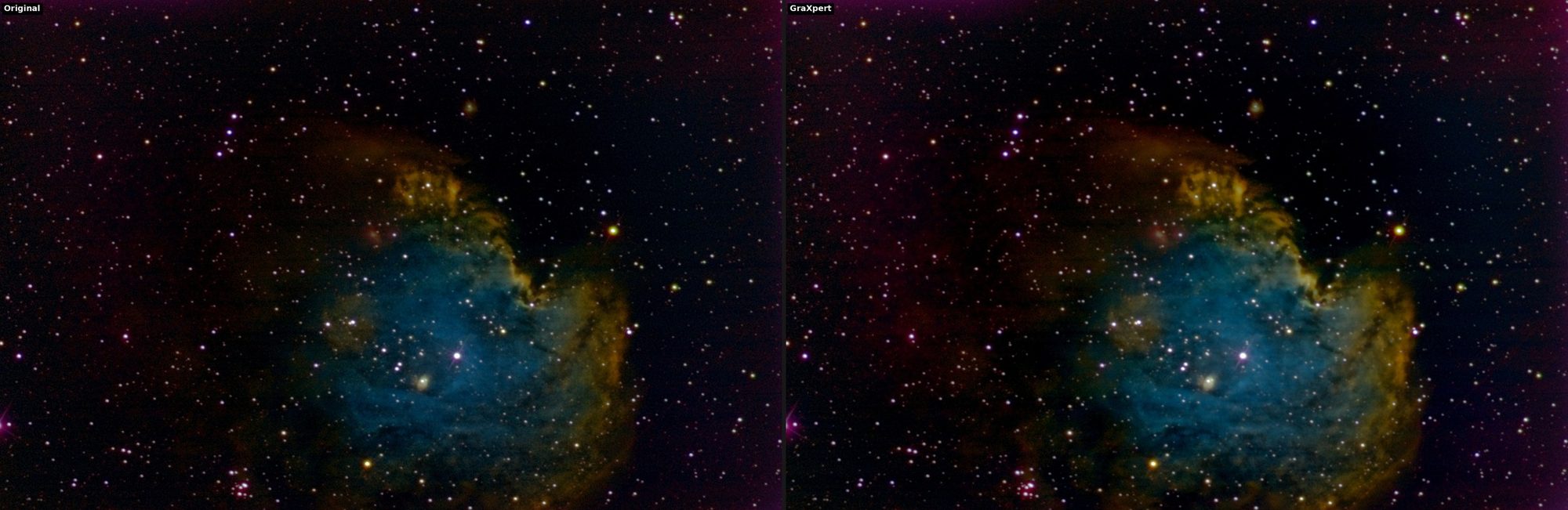
There are excellent free image-processing tools, and I don’t want to reinvent the wheel. So the aim for TelescopeYoke’s pictures is now to automate them as well as possible. Anyone who wants the yoke to process their images can download the tools themselves, and everything else works without them.
A tool only replaces a step if it does at least as well on my own stacks. Everything runs on copies, and nothing from these tools goes near a measurement.
Noise reduction: GraXpert
I ran each tool on ten half-stacks of IC 405 and NGC 2174 in Ha, OIII and SII, with faint artificial filaments planted in them. Each result was mixed back with its input until it had half the original grain, so they’re compared at equal noise. Error is measured against an independent stack of different frames, as a share of a plain blur’s error, so lower is better.
| Method | Filament kept | Error against blur |
|---|---|---|
| Plain blur | 96.4% | 1.000 |
| GraXpert 3.0.2 | 88.5% | 0.971 |
| DeepSNR 1.3.2 | 89.1% | 0.974 |
| Cosmic Clarity (AI3.6) | 85.9% | 0.985 |
| Siril NL-Bayes, defaults | 76.0% | 1.017 |
| Seti Astro Suite Pro AI4 denoise | 65.3% | 1.027 |
GraXpert won, and it’s now built into the colour pictures. DeepSNR came very close: it kept a little more of the filament, but it was a little further from the independent stack at every noise level, so it doesn’t beat GraXpert on both. The suite’s newer AI4 model did worse here than the older Cosmic Clarity one. It cleans each filter while the data is still linear, and records its version and strength beside the picture.
A blur still keeps more of a thin line, so none of these is free of smoothing. The median star kept 99.9% of its flux, but the faintest 5% of stars in the worst stack read about 21% low. That’s fine for a picture and useless for photometry, so denoised data is never measured.
Background: my existing code stays
I added a known tilt, bowl and corner glow to copies of five stacks, plus four faint glows that should survive. “Left” is how much of each gradient remained.
| Method | Tilt left | Bowl left | Corner left | Faint glow kept (worst stack) |
|---|---|---|---|---|
| TelescopeYoke’s sky model | 0.11 | 0.17 | 0.19 | 88% (85%) |
| GraXpert AI | 0.13 | 0.18 | 0.10 | 86% (56%) |
| Siril polynomial | 0.09 | 0.30 | 0.62 | 90% (88%) |
| Siril RBF | 0.30 | 0.41 | 0.44 | 57% (43%) |
| Seti Astro ABE, defaults | 0.26 | 0.27 | 0.30 | 86% (84%) |
| Seti Astro ABE, polynomial only | 0.10 | 0.31 | 0.38 | 95% (90%) |
GraXpert is about twice as good on a corner glow, but on IC 405’s SII it took off 44% of a faint glow, and losing real nebula is the worse fault. My code does have an advantage here, because it uses the Ha stack to see where the nebula is. Siril ran on automatic samples, and placing them by hand may well do better, but the point here is automation. Seti Astro’s ABE with just a polynomial keeps more of a faint glow than my code, but it leaves about twice as much of a bowl or a corner glow. GraXpert’s non-AI methods couldn’t be tried, because from the command line they need sample points saved from its window.
Star removal: Dark Star, now in the pictures
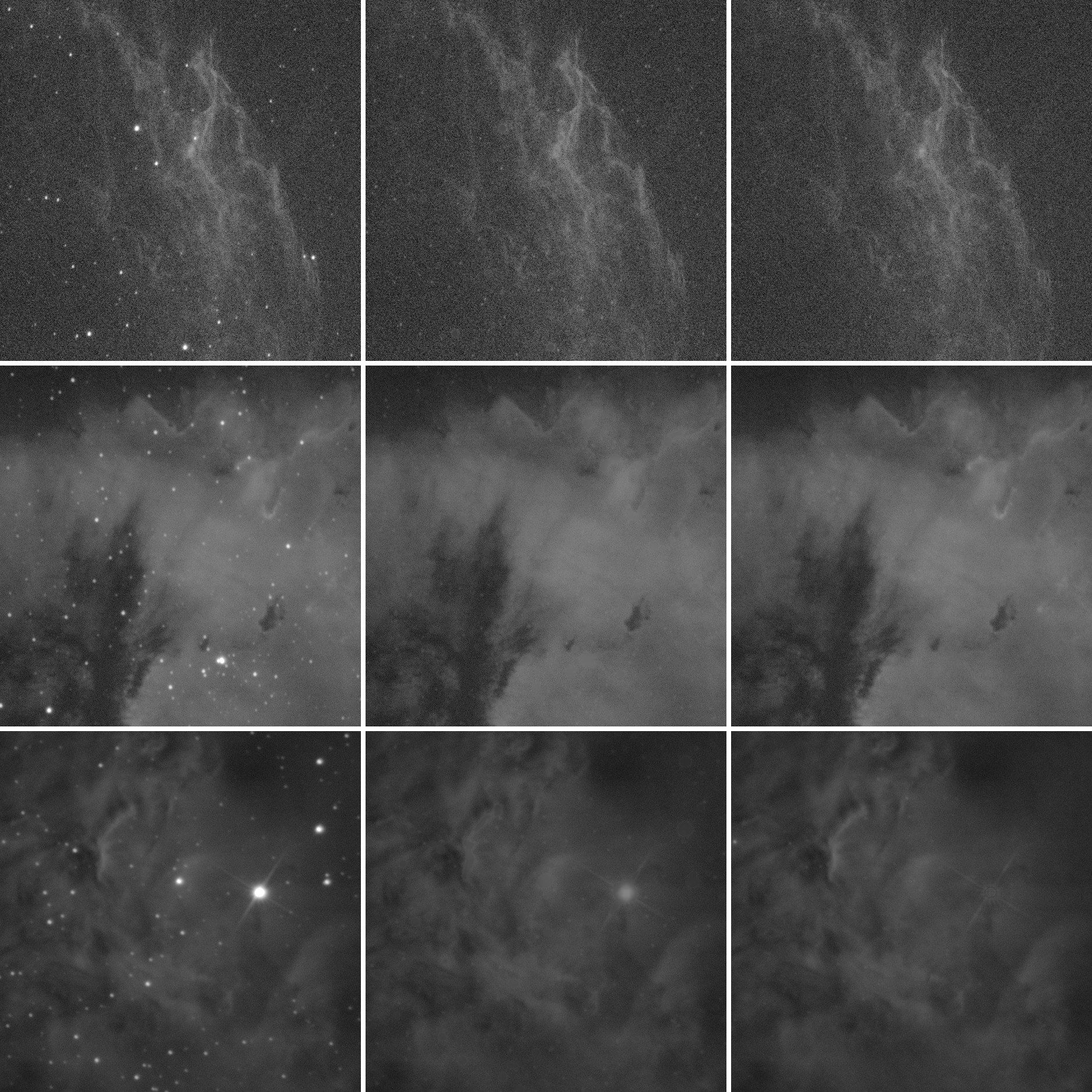
Cosmic Clarity now lives on in Seti Astro Suite Pro, whose Dark Star removes stars far better than my plain code. Used alone it also took faint nebula with it, up to 72% of a planted glow, and on stacks I hadn’t used before it kept only 1% to 62% of a planted faint line. So I use it only where stars were detected, keeping the original image everywhere else. That’s the right-hand column above.
The first version failed the pass mark I’d set in advance: keep a thin faint line to within 5 points of my code, on stacks that weren’t used to tune it. So I ran GraXpert’s noise reduction first, as a picture would, and checked again on five stacks never used before, then fixed two faults the scores showed. Very bright stars with clipped cores and close double stars both look “not round”, and were being left in. Here is the final version on five more stacks it had never seen:
| Stack | Line kept, my code | Line kept, Dark Star blend |
|---|---|---|
| M31, panel 2 | 20% | 99% |
| M31, panel 7 | 16% | 100% |
| NGC 3310 | 15% | 101% |
| SN 2026sqf’s field | 40% | 102% |
| M33 | 28% | 101% |
It passed on all of them, and it leaves almost nothing of each star. In the full NGC 2174 picture two close doubles were still left in one filter’s colour, a red one and a blue one, because each filter decided about its stars on its own. So now each star is decided once for all the filters. On M33’s red, green and blue stacks, which I hadn’t used for any of this, it kept the planted line at 102% to 105% in every filter, where my code kept 27% to 37%. The doubles are gone, the stars come out whiter, and it’s now how TelescopeYoke makes its narrowband pictures. The very brightest stars, like the Pleiades’, still stay almost whole.
StarNet2, blended the same way, scored about the same. I’m going with Dark Star.
Sharpening: nothing passes
I measured sharpening on the same ten pairs, after GraXpert: how much fine detail it adds in the nebula, how much grain on empty sky, and whether the result agrees better or worse with an independent stack of other frames. Real detail should make it agree better.
| Method | Fine detail | Grain | Agreement change | Ring beside a thin line |
|---|---|---|---|---|
| TelescopeYoke’s 3 Richardson-Lucy steps | +29% | +34% | -0.099 | deep |
| Siril deconvolution, defaults | +3% | +4% | -0.001 | none |
| Seti Astro sharpen, non-stellar | +45% | +41% | -0.029 | slight |
Nothing made the result agree better with the independent stack, so none of them is adding real detail here. Seti Astro beats my own steps on everything except grain, where it adds a little more, so it misses the mark I set. My sharpening stays off unless asked for.
Stretching: my own stays
I compared Siril’s autostretch and GHS, and Seti Astro’s statistical stretch, with TelescopeYoke’s own, on the same ten pairs. Each stack went in beside a copy with faint lines planted in it, so one stretch served both.
| Stretch | Faint lines over the grain | Bright detail |
|---|---|---|
| TelescopeYoke’s own | 12.8 | 0.012 |
| Siril autostretch | 5.5 | 0.015 |
| Seti Astro statistical stretch | 5.3 | 0.014 |
| Siril GHS | 5.9 | 0.002 |
The free tools draw the faint lines taller and keep a little more bright detail, but they lift the grain four times as much, so the faint nebula stands out half as clearly. GHS at the same sky level flattened everything.
Combining the palette: my own stays
Neither Siril nor Seti Astro has an automatic way to combine narrowband filters into a palette. Siril’s command just puts each filter in a colour channel. Done the plain free way, with Siril’s autostretch and Seti Astro’s green removal, NGC 2174 came out with a purple gradient across the sky and a flatter nebula. TelescopeYoke fits the sky and balances the filters itself.
A fault in my own stacking, found along the way
I also found that TelescopeYoke’s hot-pixel cleaning was cutting the cores of sharp stars. On Tabby’s star’s frames, stars lost 11% to 23% of their light in a tight aperture, and the light curves got about 40% noisier. Siril’s sigma rejection didn’t pass my mark either. The fix maps the sensor’s defects from each session’s own frames, and only cleans a pixel that stands alone. Restacked with it, one Tabby session kept 12% more starlight (26% more for the brightest stars) with the same noise.
Colour calibration: Siril’s SPCC crashed
For red, green and blue pictures I tried Siril’s spectrophotometric colour calibration, which uses Gaia’s star spectra to make a Sun-like star white. I checked the result against 135 Gaia stars in an M33 field. With no balance, Sun-like stars came out 0.20 magnitudes off white; with TelescopeYoke’s simple “average star is white” balance, 0.07. Siril crashed every time, just after measuring the stars, with every filter set I tried. So my own balance stays for now.
These are stacks from one telescope, with each tool as released, so your results may differ.