Lucky imaging the Moon
The 94%-lit Moon after midnight through thin haze. The telescope's deep-sky stacker was the wrong tool, so Claude built a lucky-imaging stacker during the session, and the Moon got a mode of its own.
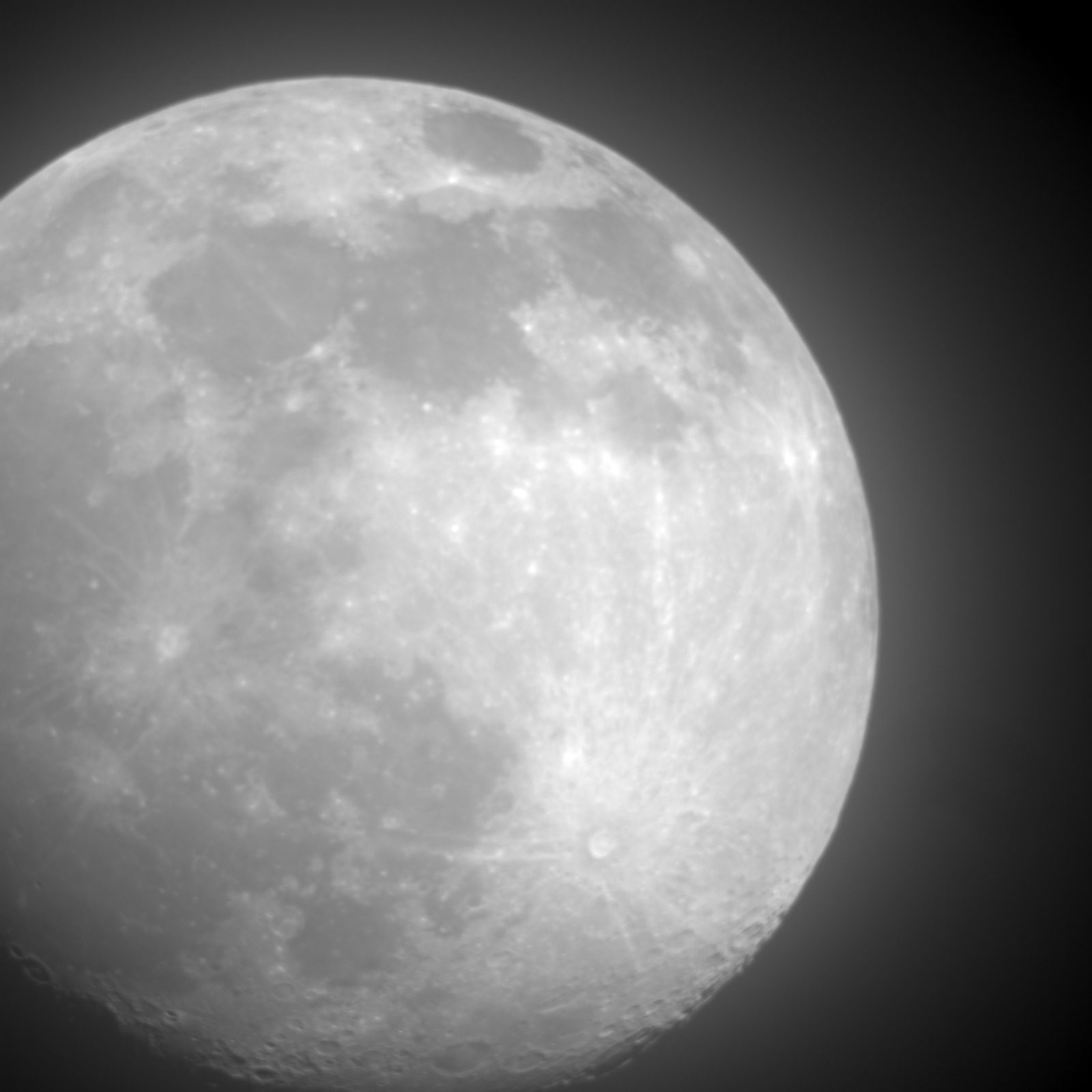
23 to 24 October. A back garden in Northern Ireland.
The Moon after midnight
At half one the Moon was looking good, so I went out. It was the only clear thing in the sky. The first GoTo missed it completely: I’d set the mount’s home position by eye, and that left it more than a frame off. Claude went to Andromeda instead, where there were stars to plate-solve. That showed the pointing was 5.6° out in declination, and the next GoTo, with that error allowed for, put the Moon in the frame.
Focus took under two minutes. The motor walked the drawtube in from just past the line on the stars of M38, from HFR 7.1 to a best of 2.2.
The wrong stacker, then the right one
The first Moon run went through the deep-sky stacker, one frame a second, lined up as whole frames. It looked fine on the stream but soft close up, with stripes from the camera fault getting in.
So I asked whether this was the best way, and it wasn’t. The Moon wants lucky imaging: a fast video, only the sharpest moments kept, and each part of the surface lined up on its own, because the air bends one crater differently from the next. Claude wrote that as a new command during the session. The camera ran in video mode, 300 frames of 20 ms from a square round the Moon, at about four frames a second. The stacker kept the sharpest and lined them up on over a thousand small patches.
No stripes, and the rays from Tycho and the small craters along the limb came out far crisper than the first stack. The left edge is cut off: the mount tracks the stars, and the Moon moves against them by about its own width an hour, so it drifted while the video was being taken.
What changed
By the end of the night the Moon had a mode of its own, ./ty moon. It finds the disc in the camera’s own picture and centres it from that, since plate solving needs stars. It sets the exposure from how bright the surface is, reads only the part of the sensor round the disc, and puts the Moon back in the middle between bursts so it can’t drift off. The stream now shows the Moon as the Moon, with how much of it is lit and how old it is, instead of a star size.
None of that has been tried on the sky yet. I parked at ten to three, with rain about.