Mapping the garden, and finding home
The telescope measured my garden's skyline by itself before dark, the true home position turned out to be ten degrees from where I had been setting it, Tabby's star got its first night, and then the camera started misbehaving and a neighbour's bonfire finished the night.
Tabby's star (KIC 8462852), from 20:58
- Night
- 17 October: 20:58 to 21:30
- Exposure
- 4 s each, gain 1,500
- Frames
- 101 kept of 150Left out: 22 left out when stacked; 14 cloud; 13 sky brightened (cloud or a light)
- Integration
- 6 min 44 s
- Star size FWHM
- 5.94 px median per frame (half of frames 5.85 to 6.04); 6.85″ across in the stack
- Sky brightness
- 18.4 magnitudes per square arcsecond
- Depth
- stars to magnitude 16.175σ limit on open sky, inferred, Gaia G (camera unfiltered) band; 2,374 stars detected
- Plate scale
- 1.32″ a pixel
- Software
- telescopeyoke v0.2.1 (4e17a52)
- Polar alignment
- 1° out to 0.5°noted
- Conditions
- Clear and cold, about -1°C; bonfire smoke at the endnoted
The night, frame by frame
| From | Frames | Kept | Star size, px (median of kept) | Sky background |
|---|---|---|---|---|
| 20:58 | 83 | 76 | 5.91 | 26 |
| 21:13 | 58 | 23 | 6.07 | 48 |
| 21:28 | 9 | 2 | 6.18 | 43 |
Where these numbers come from
Imported from telescopeyoke's session folder frames/Tabby/20261017-205809 on 2026-10-18. Values marked logged are read from these files and nothing else:
session.jsonsha256 f9c08c6852db0b34…frames.jsonsha256 0f5d3a26b9e5d22b…restack.jsonsha256 63ec742e8505d2b6…depth.jsonsha256 71d368d4a816447e…final.jpgsha256 c3f34d52c0316ce6…
Stacked by telescopeyoke 0.2.1 at 08625e6, with uncommitted changes.
Frame counts and integration are telescopeyoke's restack record; the reasons are its own words for each frame it left out, grouped. Depth and sky brightness are from its photometry of the stack (depth.json). Times are local, start of the first frame to end of the last.
Andromeda Galaxy (M31), from 21:58
- Target
- Andromeda Galaxy (M31)
- Night
- 17 October: 21:58 to 22:54
- Exposure
- 16 s each, gain 1,500
- Frames
- 68 kept of 80Left out: 12 left out when stacked
- Integration
- 18 min
- Star size FWHM
- 5.83 px median per frame (half of frames 5.72 to 5.91); 6.29″ across in the stack
- Sky brightness
- 19.03 magnitudes per square arcsecond
- Depth
- stars to magnitude 17.55σ limit on open sky, inferred, Gaia G (camera unfiltered) band; 1,782 stars detected
- Plate scale
- 1.32″ a pixel
- Software
- telescopeyoke v0.2.1 (4e17a52)
The night, frame by frame
| From | Frames | Kept | Star size, px (median of kept) | Sky background |
|---|---|---|---|---|
| 21:58 | 20 | 18 | 5.89 | 125 |
| 22:13 | 20 | 15 | 5.89 | 118 |
| 22:28 | 28 | 23 | 5.73 | 122 |
| 22:43 | 12 | 12 | 5.71 | 113 |
Where these numbers come from
Imported from telescopeyoke's session folder frames/M31/20261017-215824 on 2026-10-18. Values marked logged are read from these files and nothing else:
session.jsonsha256 eee2852732e69da3…frames.jsonsha256 8713741eb3a2c613…restack.jsonsha256 25f1ef9917d4ec09…depth.jsonsha256 c646a95487de32e0…final.jpgsha256 a5e8ecb31f74cdce…
Stacked by telescopeyoke 0.2.1 at 5f3848a.
Frame counts and integration are telescopeyoke's restack record; the reasons are its own words for each frame it left out, grouped. Depth and sky brightness are from its photometry of the stack (depth.json). Times are local, start of the first frame to end of the last.
Andromeda Galaxy (M31), from 22:55
- Target
- Andromeda Galaxy (M31)
- Night
- 17 October: 22:55 to 23:32
- Exposure
- 16 s each, gain 1,500
- Frames
- 68 kept of 80Left out: 12 left out when stacked
- Integration
- 18 min
- Star size FWHM
- 5.67 px median per frame (half of frames 5.58 to 5.72); 6.3″ across in the stack
- Sky brightness
- 19.2 magnitudes per square arcsecond
- Depth
- stars to magnitude 17.275σ limit on open sky, inferred, Gaia G (camera unfiltered) band; 1,790 stars detected
- Plate scale
- 1.32″ a pixel
- Software
- telescopeyoke v0.2.1 (562555b)
The night, frame by frame
| From | Frames | Kept | Star size, px (median of kept) | Sky background |
|---|---|---|---|---|
| 22:55 | 28 | 22 | 5.67 | 107 |
| 23:10 | 33 | 29 | 5.67 | 104 |
| 23:25 | 19 | 17 | 5.63 | 101 |
Where these numbers come from
Imported from telescopeyoke's session folder frames/M31/20261017-225507 on 2026-10-18. Values marked logged are read from these files and nothing else:
session.jsonsha256 eee2852732e69da3…frames.jsonsha256 d3276158bcbe5f3d…restack.jsonsha256 59fcf54f445dbcbc…depth.jsonsha256 a97bc571789e7ef3…final.jpgsha256 0a4bdcfb57bd1495…
Stacked by telescopeyoke 0.2.1 at 5f3848a.
Frame counts and integration are telescopeyoke's restack record; the reasons are its own words for each frame it left out, grouped. Depth and sky brightness are from its photometry of the stack (depth.json). Times are local, start of the first frame to end of the last.
Andromeda Galaxy (M31), from 23:35
- Target
- Andromeda Galaxy (M31), panel 6
- Night
- 17 October: 23:35 to 23:42
- Exposure
- 16 s each, gain 1,500
- Frames
- 16 kept of 19Left out: 3 left out when stacked
- Integration
- 4 min 16 s
- Star size FWHM
- 5.7 px median per frame (half of frames 5.62 to 5.85); 6.4″ across in the stack
- Sky brightness
- 19.31 magnitudes per square arcsecond
- Depth
- stars to magnitude 17.025σ limit on open sky, inferred, Gaia G (camera unfiltered) band; 1,322 stars detected
- Plate scale
- 1.32″ a pixel
- Software
- telescopeyoke v0.2.1 (96f157a)
The night, frame by frame
| From | Frames | Kept | Star size, px (median of kept) | Sky background |
|---|---|---|---|---|
| 23:35 | 19 | 16 | 5.70 | 93 |
Where these numbers come from
Imported from telescopeyoke's session folder frames/M31-P6/20261017-233312 on 2026-10-18. Values marked logged are read from these files and nothing else:
session.jsonsha256 89cf6f3184a597b0…frames.jsonsha256 558b11af45b33061…restack.jsonsha256 fb7499e7ae4058d1…depth.jsonsha256 215937175780fd8a…final.jpgsha256 be45f56be15c5e4e…
Stacked by telescopeyoke 0.2.1 at 5d074f3.
Frame counts and integration are telescopeyoke's restack record; the reasons are its own words for each frame it left out, grouped. Depth and sky brightness are from its photometry of the stack (depth.json). Times are local, start of the first frame to end of the last.
Andromeda Galaxy (M31), from 23:45
- Target
- Andromeda Galaxy (M31), panel 2
- Night
- 17 October: 23:45 to 23:55
- Exposure
- 16 s each, gain 1,500
- Frames
- 16 kept of 19Left out: 3 left out when stacked
- Integration
- 4 min 16 s
- Star size FWHM
- 5.67 px median per frame (half of frames 5.65 to 5.72); 6.56″ across in the stack
- Sky brightness
- 19.34 magnitudes per square arcsecond
- Depth
- stars to magnitude 17.025σ limit on open sky, inferred, Gaia G (camera unfiltered) band; 1,318 stars detected
- Plate scale
- 1.32″ a pixel
- Software
- telescopeyoke v0.2.1 (5d074f3)
The night, frame by frame
| From | Frames | Kept | Star size, px (median of kept) | Sky background |
|---|---|---|---|---|
| 23:45 | 19 | 16 | 5.67 | 87 |
Where these numbers come from
Imported from telescopeyoke's session folder frames/M31-P2/20261017-234443 on 2026-10-18. Values marked logged are read from these files and nothing else:
session.jsonsha256 867b6580179a4564…frames.jsonsha256 46a902b7ad74b879…restack.jsonsha256 957ee3700ec81b8f…depth.jsonsha256 25b27d8ac0fcc5a6…final.jpgsha256 746c14857ecc85da…
Stacked by telescopeyoke 0.2.1 at 5d074f3, with uncommitted changes.
Frame counts and integration are telescopeyoke's restack record; the reasons are its own words for each frame it left out, grouped. Depth and sky brightness are from its photometry of the stack (depth.json). Times are local, start of the first frame to end of the last.
Andromeda Galaxy (M31), from 00:56
- Target
- Andromeda Galaxy (M31), panel 4
- Night
- 17 October: 00:56 to 01:06
- Exposure
- 16 s each, gain 1,500
- Frames
- 16 kept of 19Left out: 3 left out when stacked
- Integration
- 4 min 16 s
- Star size FWHM
- 5.75 px median per frame (half of frames 5.54 to 5.79); 6.53″ across in the stack
- Sky brightness
- 18.93 magnitudes per square arcsecond
- Depth
- stars to magnitude 16.775σ limit on open sky, inferred, Gaia G (camera unfiltered) band; 1,248 stars detected
- Plate scale
- 1.32″ a pixel
- Software
- telescopeyoke v0.2.1 (c9c6121)
The night, frame by frame
| From | Frames | Kept | Star size, px (median of kept) | Sky background |
|---|---|---|---|---|
| 00:56 | 19 | 16 | 5.75 | 81 |
Where these numbers come from
Imported from telescopeyoke's session folder frames/M31-P4/20261018-005538 on 2026-10-18. Values marked logged are read from these files and nothing else:
session.jsonsha256 03d460c7360bc93c…frames.jsonsha256 859406619a6aed8c…restack.jsonsha256 dabb200ca4b54e2a…depth.jsonsha256 6519709af7349999…final.jpgsha256 296d9e770edf172c…
Stacked by telescopeyoke 0.2.1 at 397c151.
Frame counts and integration are telescopeyoke's restack record; the reasons are its own words for each frame it left out, grouped. Depth and sky brightness are from its photometry of the stack (depth.json). Times are local, start of the first frame to end of the last.
Saturday 17 October. Clear, cold and, by the end, smoky. A back garden in Northern Ireland.
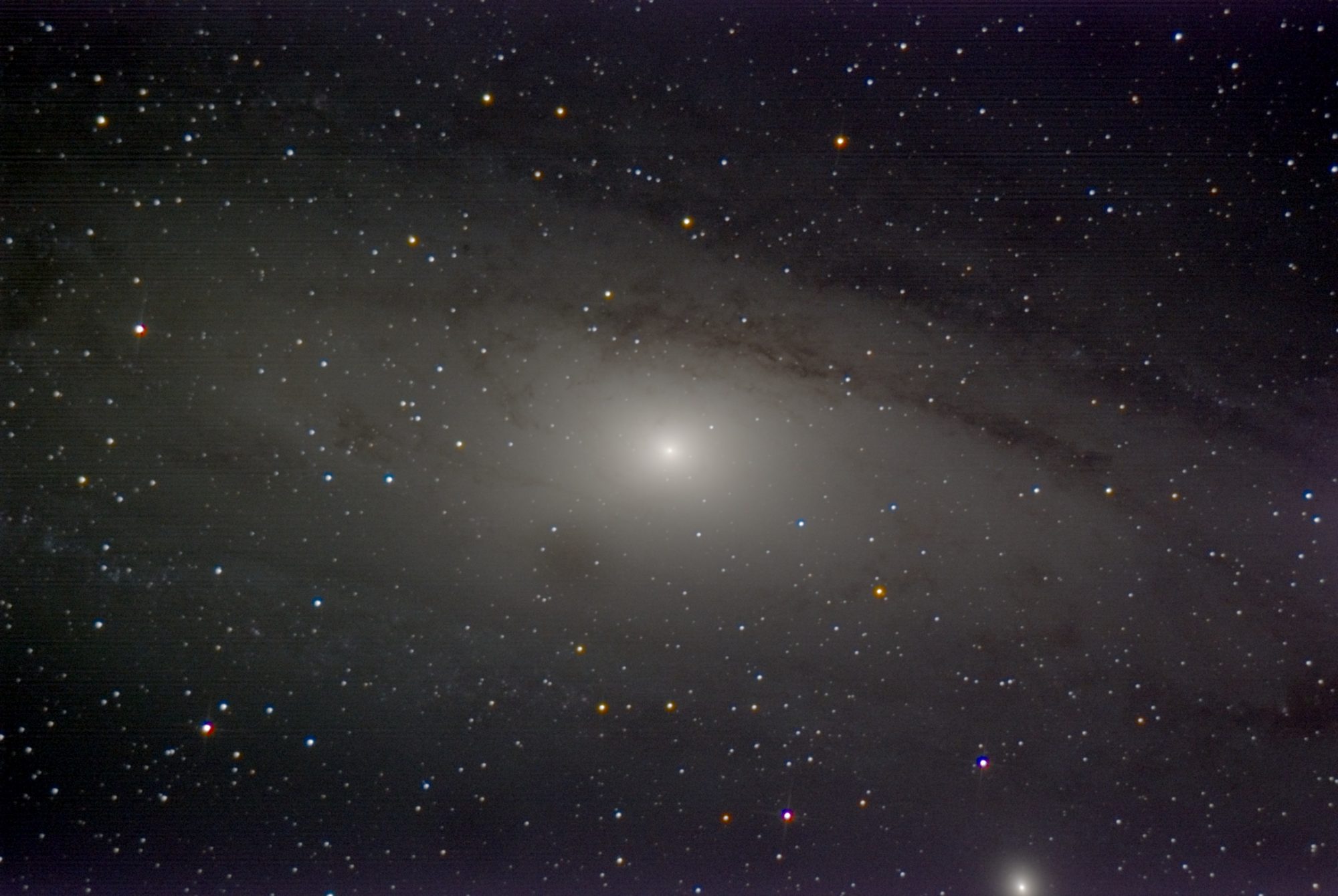
The Andromeda Galaxy, M31. 68 frames of 16 seconds, dithered. The faint horizontal lines are the camera’s stripes, which were stronger tonight than on any night before; in the run without dithering they are worse.
The telescope maps the garden
Before dark, with the Sun still up, the telescope surveyed its own skyline. It points at the horizon round the compass, takes a picture each time and decides whether it is looking at sky or at something in the way, moving up or down until it finds the top. A hundred looks over 28 directions took 34 minutes. When it said “blocked” at the hedge to the south-east I was standing beside it, and it was looking straight at the hedge.
What it found is not good news for the west. The house closes off the whole of it, rising to more than 75° up. The hedge and trees hide the east and south-east below about 40 to 48°. The only low view is a gap to the south-south-west, down to 22°. The night planner now knows all this, and it cut the targets it would suggest from 265 to 177, and every exoplanet transit tonight, as each one passes behind the house at some point.
Focus: measure first
Focus had not been touched since the last night, and the first reading showed it was still better than usual. The software went ahead and ran a full focus anyway, driving the focuser well out and back in, and when that was stopped part way it left the focus worse than it started. It got it back to a good 2.14 in the end, but now it measures first, tells me the number and only focuses if it needs it.
Polar alignment
The tripod had not moved, yet the polar axis was a degree out, against 0.1° the last time. A few turns of the azimuth bolts brought it to 0.5°, which is good enough. A turn of those bolts moves the axis about 1.7° on this mount, far more than the software first guessed from a quarter turn.
Finding home
Every night I set the mount to its home position by eye: counterweight bar down, telescope pointing at the pole. Tonight Claude measured where home really is, from seven pictures of the sky round both sides of the mount, and mine was 10.7° out on one axis and 5° on the other. That explains why the first GoTo of every night lands so far off. The software had a limit saying a home that far out could not be right, which we took out: home is where it is. It drove the mount to the real home and I marked both joints with tape. Switched off and on again on the marks, the same measurement found home within 0.2°.
The same pictures showed that one pointing correction for each side of the sky is enough, so GoTos should land close from now on.
Tabby’s star
Tabby’s star (KIC 8462852) is a star that dims by large amounts with no regular pattern, and nobody is sure why. Tonight it got its first look before it went behind the roof: 101 frames of 4 seconds, and magnitude 11.655, measured to about 2%. Two more nights and the software will have a usual level to spot a dip against. Two of its frames were thrown out because someone switched the kitchen light on.
Dithering, and what it costs
Dithering means moving the telescope a tiny amount every few frames, so the camera’s own flaws don’t line up on the same stars. I took 80 frames of Andromeda dithered and 80 without, to see if it lowers the noise. The dithered run took 56 minutes and the plain one 37: each dither was a full GoTo with plate solving and a 30 second wait, one to three minutes to move a fraction of an arcminute. Now a dither is a single quick GoTo and the wait is 10 seconds.
The patrol, and the camera
Just before midnight the telescope started patrolling Andromeda panel by panel, searching each for anything new. A page on the laptop now shows the whole mosaic as it goes. Three panels were searched, but the camera kept hanging in between: it stopped sending long exposures, while the short ones it uses to find where it’s pointing kept working.
Then there were the stripes: faint horizontal bands across the frames. I wasn’t happy with them and kept saying so. Measured against every earlier night, they were 40% stronger tonight, on the same lead and the same USB port. Taking frames through Altair’s own camera software instead of the usual driver, the long exposures failed in just the same way, so it’s the camera, not the software. It was the coldest night yet, about -1°C. Whether that’s the cause, or the camera has a fault, is tomorrow’s job, with the camera warmed up indoors.
Smoke
To finish it off, it started smelling smoky outside, a bonfire somewhere nearby. The smoke brightened the sky and blurred the stars to three times their size. The mount went home onto its new marks at about 02:30, and that was the night.