Andromeda from both sides of the sky, the Pleiades and Saturn
The polar alignment I thought was 0.2 degrees was really 3, the camera's short exposures got fixed, and an hour and a half of Andromeda came out of two runs stitched across the meridian.
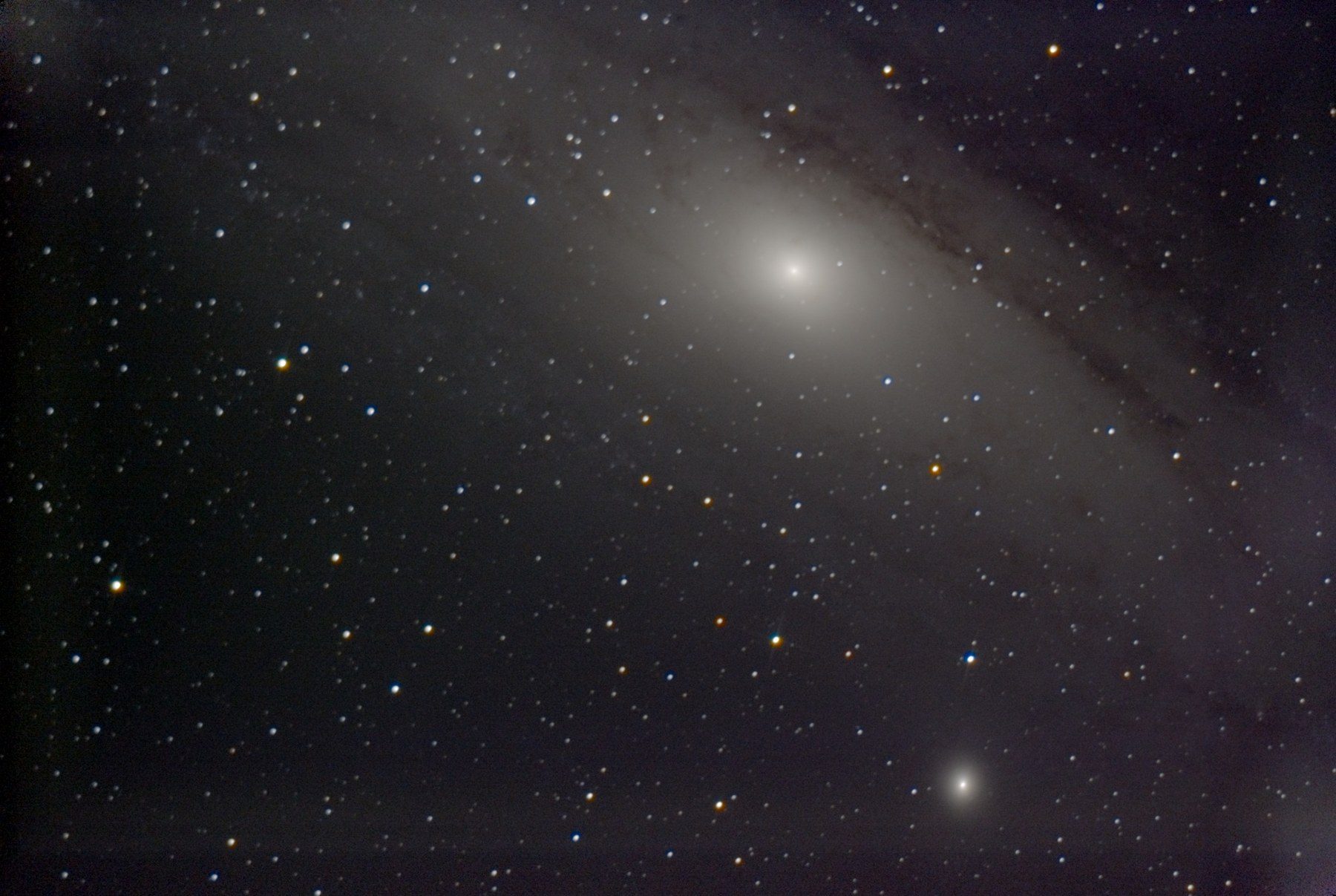
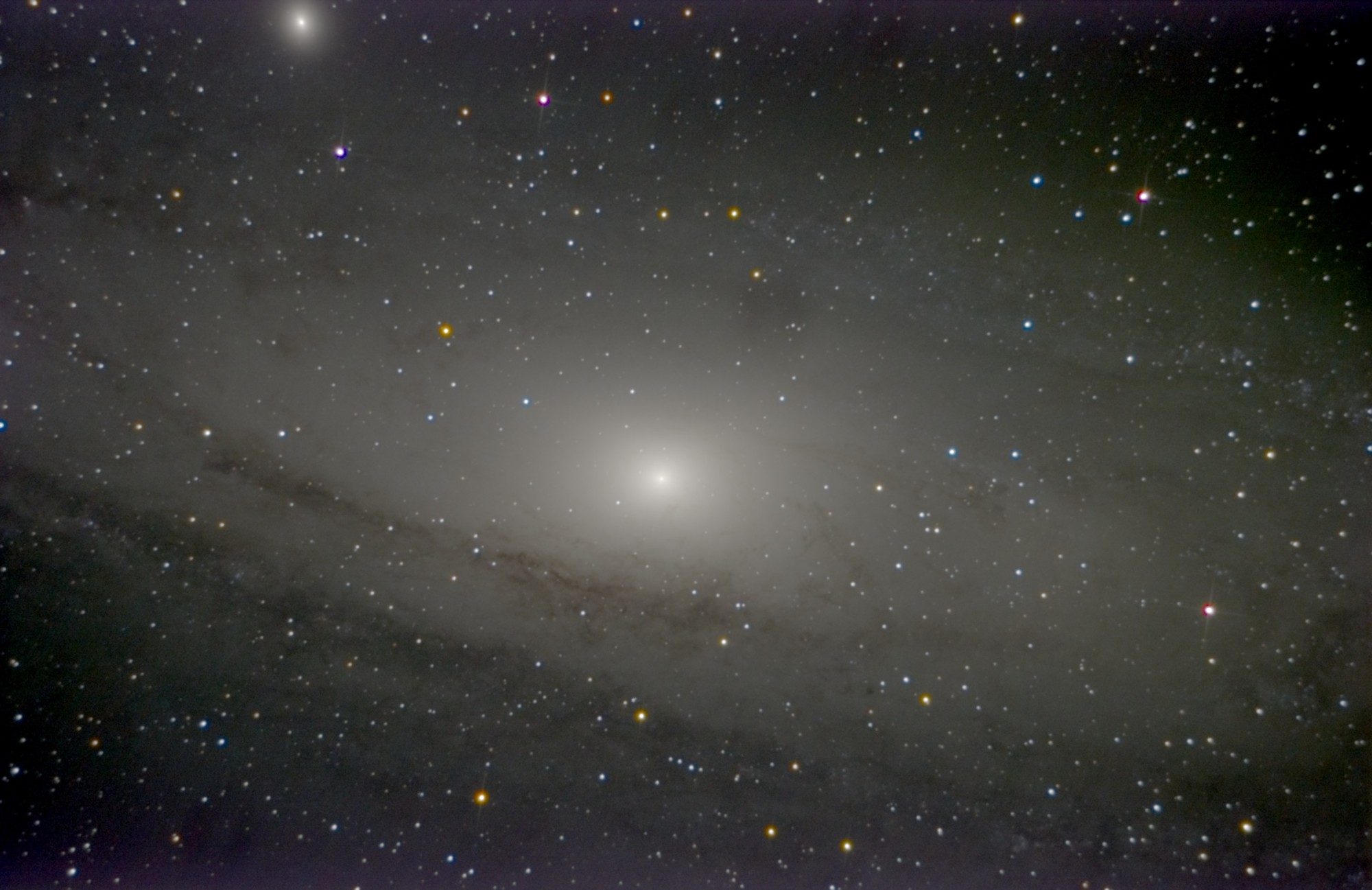
The Andromeda Galaxy, M31. 358 frames of 16 seconds, an hour and 35 minutes in all, from two runs either side of the meridian. M32 is at top left this time because the picture is the other way up from the last one.
Andromeda Galaxy (M31), from 23:26
- Target
- Andromeda Galaxy (M31)
- Night
- 13 October: 23:26 to 00:48
- Exposure
- 16 s each, gain 1,500
- Frames
- 202 kept of 256Left out: 36 left out when stacked; 18 cloud
- Integration
- 54 min
- Star size FWHM
- 5.87 px median per frame (half of frames 5.81 to 5.93); 6.37″ across in the stack
- Sky brightness
- 19.12 magnitudes per square arcsecond
- Depth
- stars to magnitude 17.915σ limit on open sky, inferred, Gaia G (camera unfiltered) band; 1,998 stars detected
- Plate scale
- 1.32″ a pixel
- Software
- telescopeyoke v0.2.1 (acacabf)
- Polar alignment
- About 3° out, corrected to 0.1°noted
The night, frame by frame
| From | Frames | Kept | Star size, px (median of kept) | Sky background |
|---|---|---|---|---|
| 23:26 | 44 | 33 | 5.91 | 124 |
| 23:41 | 48 | 42 | 5.83 | 114 |
| 23:56 | 47 | 42 | 5.88 | 104 |
| 00:11 | 48 | 39 | 5.87 | 104 |
| 00:26 | 48 | 39 | 5.86 | 109 |
| 00:41 | 21 | 7 | 5.78 | 152 |
Where these numbers come from
Imported from telescopeyoke's session folder frames/M31/20261013-232632 on 2026-10-17. Values marked logged are read from these files and nothing else:
session.jsonsha256 d275115b2f615bd1…frames.jsonsha256 f586f3b343264130…restack.jsonsha256 e3154b2646fdcab1…depth.jsonsha256 07985c7db38d6564…final.jpgsha256 3a780c41db7baa38…
Frame counts and integration are telescopeyoke's restack record; the reasons are its own words for each frame it left out, grouped. Depth and sky brightness are from its photometry of the stack (depth.json). Times are local, start of the first frame to end of the last.
Pleiades (M45), from 01:23
- Target
- Pleiades (M45)
- Night
- 13 October: 01:23 to 02:00
- Exposure
- 16 s each, gain 1,500
- Frames
- 77 kept of 116Left out: 39 left out when stacked
- Integration
- 21 min
- Star size FWHM
- 5.48 px median per frame (half of frames 5.39 to 5.6)
- Software
- telescopeyoke v0.2.1 (134363c)
The night, frame by frame
| From | Frames | Kept | Star size, px (median of kept) | Sky background |
|---|---|---|---|---|
| 01:23 | 46 | 20 | 5.35 | 115 |
| 01:38 | 47 | 37 | 5.60 | 136 |
| 01:53 | 23 | 20 | 5.45 | 130 |
Where these numbers come from
Imported from telescopeyoke's session folder frames/M45/20261014-012245 on 2026-10-17. Values marked logged are read from these files and nothing else:
session.jsonsha256 ecf2509716a6abcb…frames.jsonsha256 9c9fc0dc7f89f2d8…restack.jsonsha256 c465bc4e9965e98e…final.jpgsha256 9e060e69ae991ab4…
Frame counts and integration are telescopeyoke's restack record; the reasons are its own words for each frame it left out, grouped. Depth and sky brightness are from its photometry of the stack (depth.json). Times are local, start of the first frame to end of the last.
Andromeda Galaxy (M31), from 02:11
- Target
- Andromeda Galaxy (M31)
- Night
- 13 October: 02:11 to 03:43
- Exposure
- 16 s each, gain 1,500
- Frames
- 164 kept of 226Left out: 30 left out when stacked; 21 cloud; 6 sky brightened (cloud or a light); 5 stars trailed (wind or a knock)
- Integration
- 44 min
- Star size FWHM
- 5.85 px median per frame (half of frames 5.73 to 5.98); 6.6″ across in the stack
- Sky brightness
- 18.72 magnitudes per square arcsecond
- Depth
- stars to magnitude 17.715σ limit on open sky, inferred, Gaia G (camera unfiltered) band; 1,761 stars detected
- Plate scale
- 1.32″ a pixel
- Software
- telescopeyoke v0.2.1 (134363c)
The night, frame by frame
| From | Frames | Kept | Star size, px (median of kept) | Sky background |
|---|---|---|---|---|
| 02:11 | 45 | 39 | 5.84 | 146 |
| 02:26 | 38 | 34 | 5.76 | 152 |
| 02:41 | 20 | 18 | 6.01 | 113 |
| 02:56 | 19 | 9 | 6.00 | 122 |
| 03:11 | 48 | 37 | 5.81 | 126 |
| 03:26 | 49 | 27 | 5.83 | 122 |
| 03:41 | 7 | 0 | none kept | 79 |
Where these numbers come from
Imported from telescopeyoke's session folder frames/M31/20261014-021118 on 2026-10-17. Values marked logged are read from these files and nothing else:
session.jsonsha256 d275115b2f615bd1…frames.jsonsha256 f240e7b119759e30…restack.jsonsha256 87072c80c78211a4…depth.jsonsha256 35eed0e8d18e10ff…final.jpgsha256 4d0839041cb3478a…
Frame counts and integration are telescopeyoke's restack record; the reasons are its own words for each frame it left out, grouped. Depth and sky brightness are from its photometry of the stack (depth.json). Times are local, start of the first frame to end of the last.
Andromeda Galaxy (M31), both runs stacked
- Target
- Andromeda Galaxy (M31)
- Night
- 13 October: 23:26 to 03:43
- Exposure
- 16 s each, gain 1,500
- Frames
- 358 kept of 482
- Integration
- 1 h 35 min
- Star size FWHM
- 6.36″ across in the stack
- Sky brightness
- 18.98 magnitudes per square arcsecond
- Depth
- stars to magnitude 17.925σ limit on open sky, inferred, Gaia G (camera unfiltered) band; 1,906 stars detected
- Plate scale
- 1.32″ a pixel
- Software
- telescopeyoke v0.2.1 (134363c)
Where these numbers come from
Imported from telescopeyoke's session folder frames/M31/combined on 2026-10-17. Values marked logged are read from these files and nothing else:
restack.jsonsha256 95d5e48dffcb7e71…depth.jsonsha256 12193f90ab32b1b1…final.jpgsha256 dfb254a5aae959f8…
Frame counts and integration are telescopeyoke's restack record; the reasons are its own words for each frame it left out, grouped. Depth and sky brightness are from its photometry of the stack (depth.json). Times are local, start of the first frame to end of the last.
The polar alignment was never 0.2°
On 6 October the software said the polar axis was 0.2° from the pole, but the mount still drifted badly. This time we found out why. Every time the handset does a GoTo, it nudges the other axis a little too, by a tenth of a degree or so. The software assumed only one axis had turned, and that tiny error threw its answer right off. Measured from the east side of the sky it said one thing, and from the west side something completely different.
Once Claude allowed for the nudge, both sides agreed: the axis was about 3° out, too high and too far east. A drift test, which just watches how fast the stars wander, said 3.2°. So every polar figure before tonight was wrong.
With the corrected measurement I got it down to 0.1°, and the stars’ drift across the picture fell to under a quarter of what it had been. One thing I learned about the mount: the rear altitude bolt is stiff. It will push the axis down, but to bring it back up I have to help it by hand. One full turn is about 2°.
The camera’s exposures, fixed
Since the first night the camera has been giving short exposures. Ask for 10 seconds and you get about 6.4. It turns out to depend on a “speed” setting in the camera’s driver, which sets how fast the picture is read off over USB. At the default speed it gives 0.63 of what is asked. Claude measured this with star trails: with the tracking off, a star draws a line whose length tells you exactly how long the shutter was open. The software now asks for the longer time that gives the exposure I want. A 10 second test came out at 9.6.
How long each picture
A friend who has been doing this for years said to go to 16 seconds. Claude checked first, with test frames from 2 to 16 seconds, and the stars stayed round all the way up. They get a bit bigger with longer exposures, but the gain in faint detail is worth it. All tonight’s runs were at 16 seconds.
Alerts in the living room
I don’t want to keep checking a laptop screen from the sofa, so the living room light now tells me how things are going:
- orange when the stars start to fade,
- purple when cloud has taken them,
- blue when rain is on the way,
- green when the sky clears again.
The Google speaker says it out loud as well, when it can be found on the network, which is about half the time so far.
The targets
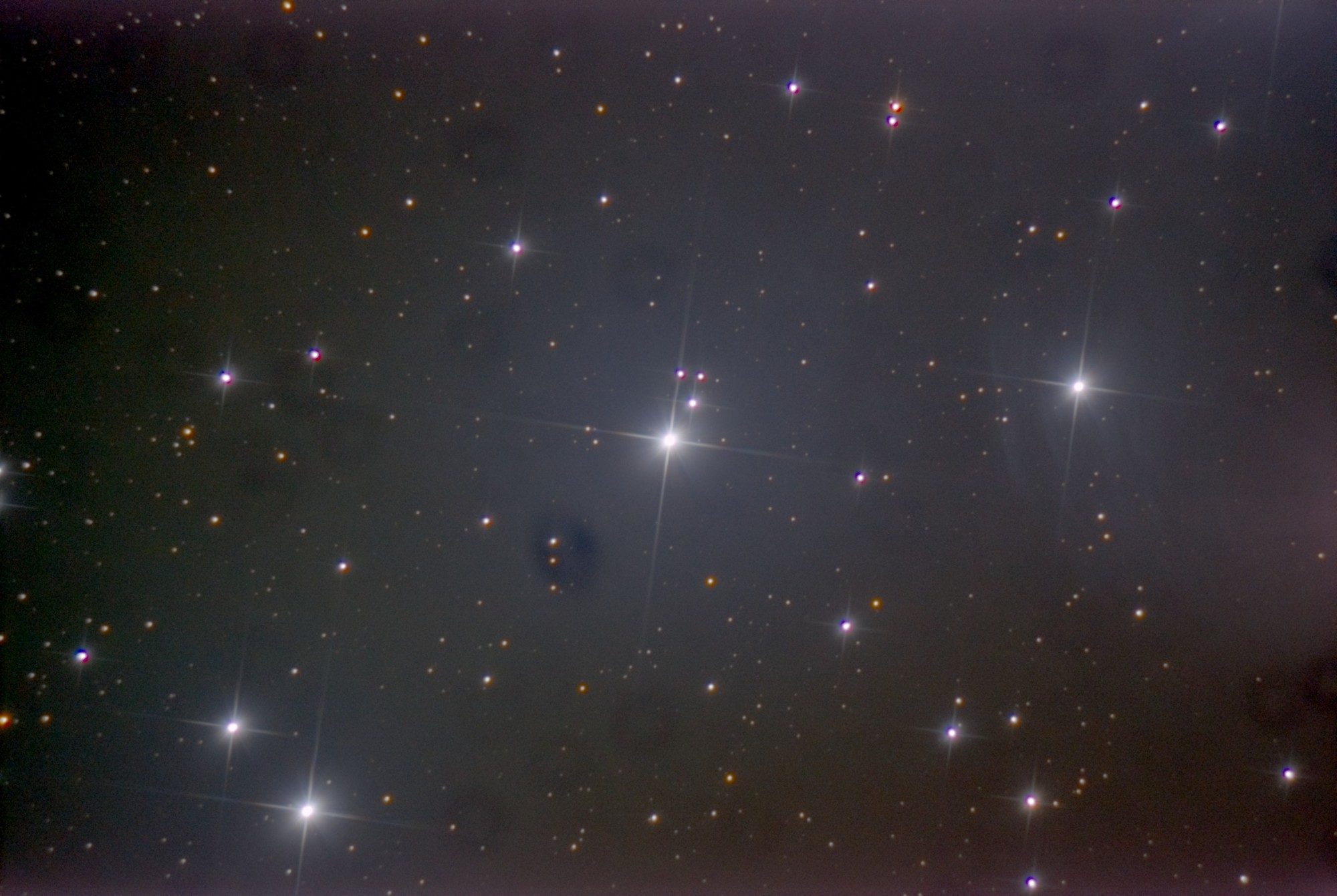
The Pleiades, M45. 113 frames, half an hour. The blue haze is dust the cluster is passing through, lit by its stars. The dark ring below the middle is dust on the camera.
- Andromeda, east of the meridian: 202 frames, 54 minutes.
- The Pleiades: half an hour while Andromeda crossed the meridian.
- Saturn: 160 very short frames, a fiftieth of a second each, keeping the sharpest 40.
- Andromeda again, west of the meridian: 164 frames, 44 minutes, and then the house lights went on. Light from the back of the house brightened the sky and frames got thrown out. I need to get some curtains.
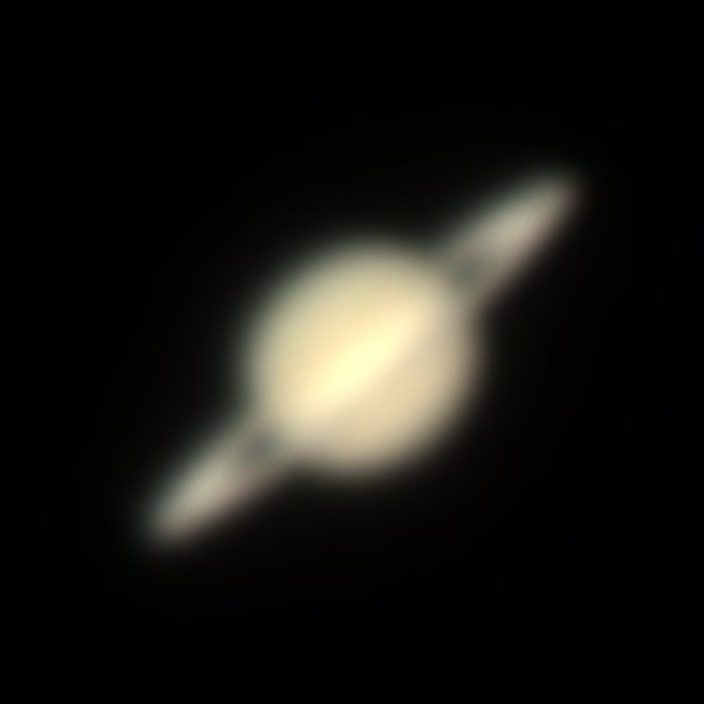
Saturn, at 750 mm with no Barlow lens, so it is tiny. The rings are clear, and the gap between them and the planet shows on both sides. A 2× Barlow and a faster way of capturing are next for planets.
Putting the two Andromeda runs together
When a mount like mine passes the meridian, the tube swings over to the other side and everything comes out upside down. The software is meant to spot those frames and turn them round. The first time we stacked the two runs, the galaxy came out twice, side by side. Only 8 of the 226 upside-down frames had been turned. In a field this full of stars, an upside-down frame still lines up with enough stars by chance to pass the check. Claude changed it to try the other way up whenever the fit is poor. The second time, all 228 were turned and the galaxy came out once, lined up to under a third of a pixel.
The two runs weren’t framed quite the same, so the edges only one of them covered came out as a lighter strip. The stacker now trims those edges off by itself.
The laptop went to sleep on battery at half five in the morning, partway through the first combining run. The PC in the house is far faster and is the right place for this kind of job, so that is next.