Polar alignment, Andromeda, and half an hour pointed at a tree
The polar axis went from six degrees out to 0.2, the Andromeda Galaxy filled the frame, and then the motors quietly stopped.
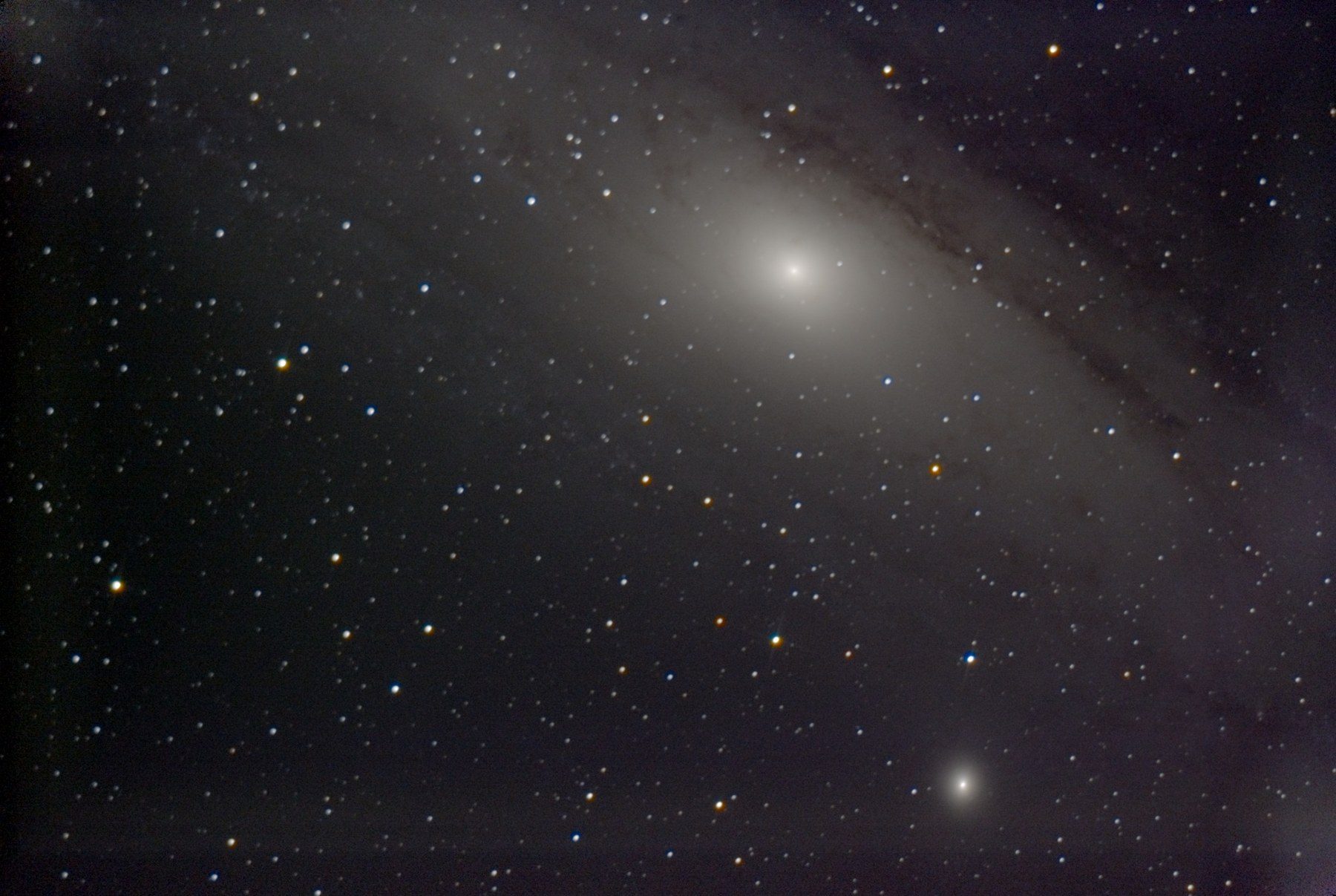
The Andromeda Galaxy, M31. It is far wider than the frame: this is the core, the dust lanes, and the companion M32 at lower right.
Andromeda Galaxy (M31), from 21:50
- Target
- Andromeda Galaxy (M31)
- Night
- 6 October: 21:50 to 22:30
- Exposure
- 15 s each, gain 1,500
- Frames
- 120 kept of 207Left out: 57 cloud; 30 left out when stacked
- Integration
- 30 min
- Star size FWHM
- 6.05 px median per frame (half of frames 5.86 to 6.16); 7.86″ across in the stack
- Sky brightness
- 18.84 magnitudes per square arcsecond
- Depth
- stars to magnitude 17.225σ limit on open sky, inferred, Gaia G (camera unfiltered) band; 1,362 stars detected
- Plate scale
- 1.321″ a pixel
- Software
- telescopeyoke v0.2.1 (0324040)
- Polar alignment
- About 6° out to 0.2°, as the software then saidnoted
The night, frame by frame
| From | Frames | Kept | Star size, px (median of kept) | Sky background |
|---|---|---|---|---|
| 21:50 | 81 | 39 | 5.98 | 95 |
| 22:05 | 69 | 59 | 6.03 | 70 |
| 22:20 | 57 | 22 | 6.14 | 84 |
Where these numbers come from
Imported from telescopeyoke's session folder frames/M31/20261006-214958 on 2026-10-17. Values marked logged are read from these files and nothing else:
session.jsonsha256 ed263a5dc3c22baf…frames.jsonsha256 8af23011eec0d42a…restack.jsonsha256 7af563bb2a232d64…depth.jsonsha256 8b7faf09397a2686…final.jpgsha256 0cea9f088699aa96…
Frame counts and integration are telescopeyoke's restack record; the reasons are its own words for each frame it left out, grouped. Depth and sky brightness are from its photometry of the stack (depth.json). Times are local, start of the first frame to end of the last.
Polar alignment
I had set the mount’s polar axis with a phone compass, and it turned out to be about 6° off. The software measures the error from plate-solved pictures and says which way to turn the bolts. Five rounds brought it down to 0.2°.
- The latitude scale on the mount reads one to two degrees high.
- The garden gets in the way. The house blocks the west-north-west and a tree the east-north-east, and the first attempts swung the telescope into both. Smaller swings, starting from Deneb, worked.
Even at 0.2° the mount still drifted about 44 arcminutes an hour on M31, far more than that error explains. I don’t yet know why.
Focus
Early on I thought the tree was in the way. It wasn’t: the focus was so far out that there was nothing to see. Lessons from that:
- Focus on a field rich in stars, near Deneb or Vega, and not on a sparse one like M31’s.
- Turning the camera in the focuser shifts the focus, so check it afterwards.
The motors stopped
Late on, the mount stopped moving without a sound, while the handset went on reporting every move as made. For half an hour the computer believed it was touring the sky while the tube sat pointing at one tree. I was standing beside it saying so.
A power cycle fixed it. The cause is unknown; a USB lead may have caught. The software now checks from the camera’s pictures that the telescope really turned, and stops if it didn’t.
The camera’s exposures run short
Asked for 2, 5, 10, 15 and 20 seconds, the camera took 2.3, 4.2, 7.3, 10.5 and 13.7. Each second asked for adds about 0.63 of a second, so a “15 second” frame is nearer ten. The fault seems to be below my software, in the camera’s driver or library, and it is not fixed yet.