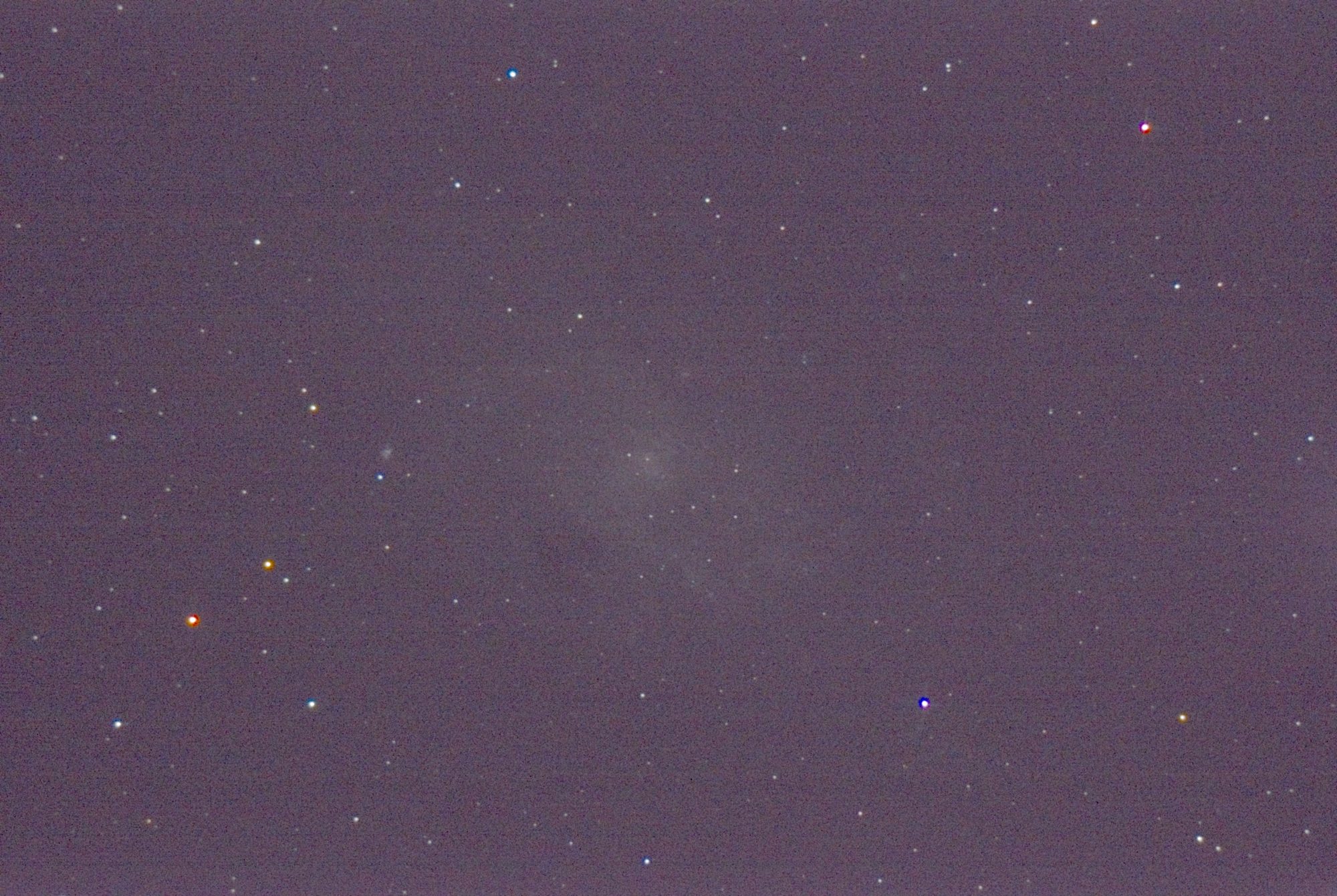
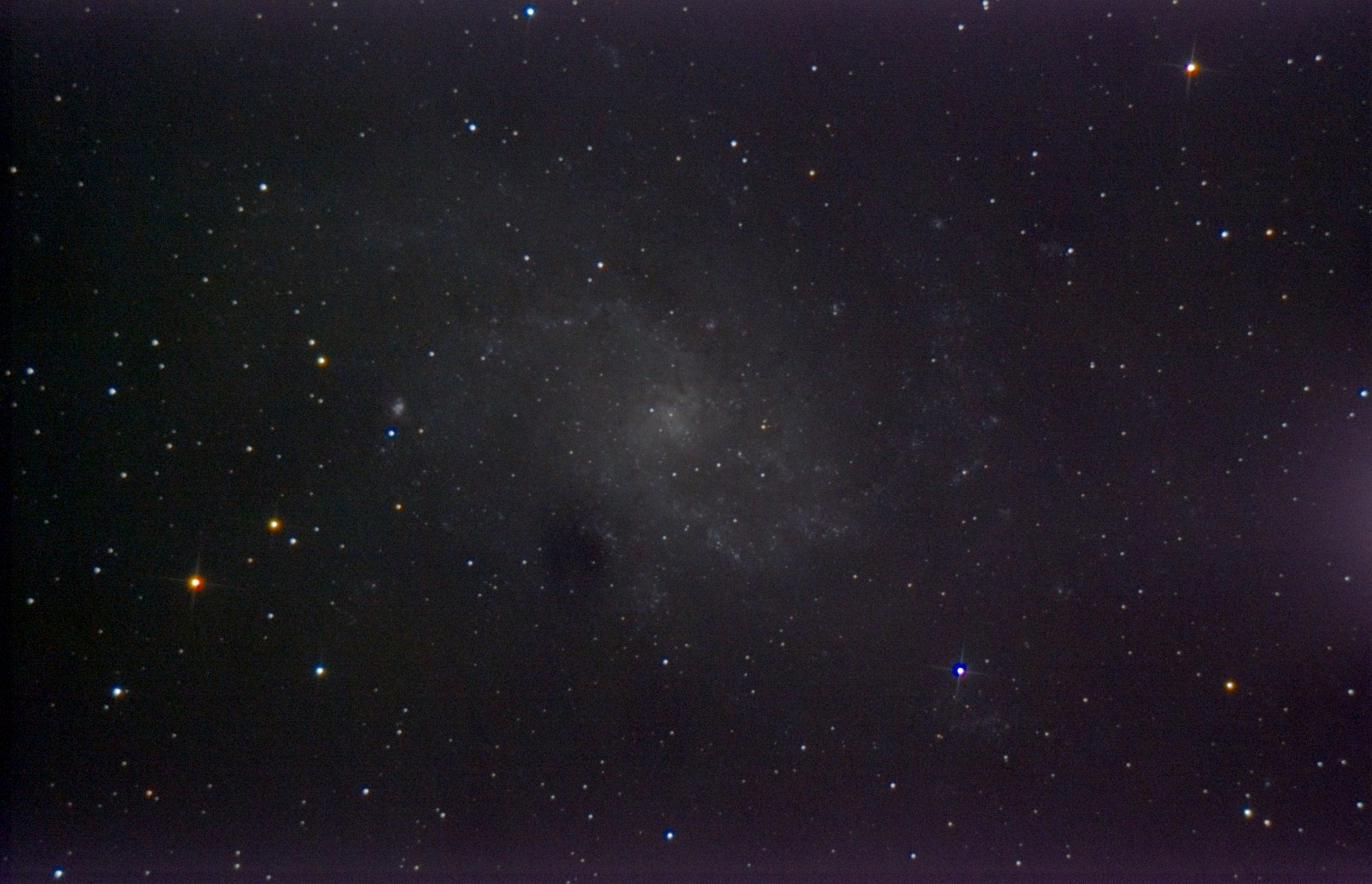
The focuser focuses itself, and the Triangulum Galaxy through a gap in the cloud
First night with the motor focuser doing the work, polar alignment from 8 degrees out to 0.3, a start on the North America Nebula, then haze, and the Triangulum Galaxy after midnight.
The Triangulum Galaxy, M33, three million light years away. 145 frames of 10 seconds. The small bright knot to the left of the core is NGC 604, a huge cloud where stars are forming. The dark smudge below the centre is dust on the camera: it sits in exactly the same place in the other picture from tonight.
North America Nebula (NGC 7000), from 21:30
- Target
- North America Nebula (NGC 7000), panel 4
- Night
- 15 October: 21:30 to 21:45
- Exposure
- 10 s each, gain 1,500
- Frames
- 31 kept of 61Left out: 23 cloud; 6 left out when stacked; 1 sky brightened (cloud or a light)
- Integration
- 5 min 10 s
- Star size FWHM
- 5.77 px median per frame (half of frames 5.66 to 5.84)
- Software
- telescopeyoke v0.2.1 (e214bbd)
- Polar alignment
- 8.3° out to 0.3°noted
- Conditions
- High haze from the North America panel on; clear towards Triangulum after midnightnoted
The night, frame by frame
| From | Frames | Kept | Star size, px (median of kept) | Sky background |
|---|---|---|---|---|
| 21:30 | 61 | 31 | 5.77 | 120 |
Where these numbers come from
Imported from telescopeyoke's session folder frames/NGC7000-P4/20261015-213006 on 2026-10-17. Values marked logged are read from these files and nothing else:
session.jsonsha256 a30a1acd2d7d517a…frames.jsonsha256 d1efb90f80e7cce7…restack.jsonsha256 413fae40374c9c01…final.jpgsha256 42256a6fd35f92f8…
Frame counts and integration are telescopeyoke's restack record; the reasons are its own words for each frame it left out, grouped. Depth and sky brightness are from its photometry of the stack (depth.json). Times are local, start of the first frame to end of the last.
North America Nebula (NGC 7000), from 21:48
- Target
- North America Nebula (NGC 7000), panel 4
- Night
- 15 October: 21:48 to 00:29
- Exposure
- 10 s each, gain 1,500
- Frames
- 170 kept of 645Left out: 445 cloud; 30 left out when stacked
- Integration
- 28 min
- Star size FWHM
- 4.7 px median per frame (half of frames 4.56 to 4.88)
- Software
- telescopeyoke v0.2.1 (811c7e2)
The night, frame by frame
| From | Frames | Kept | Star size, px (median of kept) | Sky background |
|---|---|---|---|---|
| 21:48 | 60 | 30 | 5.54 | 83 |
| 22:03 | 62 | 10 | 5.50 | 233 |
| 22:18 | 58 | 0 | none kept | 53 |
| 22:33 | 61 | 0 | none kept | 46 |
| 22:48 | 59 | 21 | 4.53 | 52 |
| 23:03 | 63 | 52 | 4.58 | 62 |
| 23:18 | 65 | 57 | 4.70 | 43 |
| 23:33 | 54 | 0 | none kept | 38 |
| 23:48 | 60 | 0 | none kept | 80 |
| 00:03 | 60 | 0 | none kept | 448 |
| 00:18 | 43 | 0 | none kept | 32 |
Where these numbers come from
Imported from telescopeyoke's session folder frames/NGC7000-P4/20261015-214751 on 2026-10-17. Values marked logged are read from these files and nothing else:
session.jsonsha256 a30a1acd2d7d517a…frames.jsonsha256 4578080a1a27eb8f…restack.jsonsha256 4d7b094c658de339…final.jpgsha256 87bbffdd17a91c60…
Frame counts and integration are telescopeyoke's restack record; the reasons are its own words for each frame it left out, grouped. Depth and sky brightness are from its photometry of the stack (depth.json). Times are local, start of the first frame to end of the last.
Triangulum Galaxy (M33), from 00:35
- Target
- Triangulum Galaxy (M33)
- Night
- 15 October: 00:35 to 02:40
- Exposure
- 10 s each, gain 1,500
- Frames
- 145 kept of 428Left out: 262 cloud; 21 left out when stacked
- Integration
- 24 min
- Star size FWHM
- 4.75 px median per frame (half of frames 4.67 to 4.8); 6.08″ across in the stack
- Sky brightness
- 18.57 magnitudes per square arcsecond
- Depth
- stars to magnitude 17.285σ limit on open sky, inferred, Gaia G (camera unfiltered) band; 1,143 stars detected
- Plate scale
- 1.32″ a pixel
- Software
- telescopeyoke v0.2.1 (811c7e2)
The night, frame by frame
| From | Frames | Kept | Star size, px (median of kept) | Sky background |
|---|---|---|---|---|
| 00:35 | 34 | 20 | 4.79 | 59 |
| 00:50 | 57 | 9 | 4.75 | 70 |
| 01:05 | 51 | 9 | 4.79 | 62 |
| 01:20 | 50 | 20 | 4.73 | 53 |
| 01:35 | 53 | 42 | 4.71 | 45 |
| 01:50 | 54 | 44 | 4.74 | 44 |
| 02:05 | 61 | 1 | 4.75 | 64 |
| 02:20 | 51 | 0 | none kept | 53 |
| 02:35 | 17 | 0 | none kept | 62 |
Where these numbers come from
Imported from telescopeyoke's session folder frames/M33/20261016-003503 on 2026-10-17. Values marked logged are read from these files and nothing else:
session.jsonsha256 6b3308735cba5d12…frames.jsonsha256 d3be96cd7ee757a3…restack.jsonsha256 2650847c7c993902…depth.jsonsha256 6412186b94f76d88…final.jpgsha256 a44fc60581451a6e…
Frame counts and integration are telescopeyoke's restack record; the reasons are its own words for each frame it left out, grouped. Depth and sky brightness are from its photometry of the stack (depth.json). Times are local, start of the first frame to end of the last.
The focuser does its own focusing
This was the first night the motor focuser did the whole job. Claude now has a routine for it. The motor winds the focuser out until the stars are clearly blurred, creeps back in a little at a time while measuring them, goes past the sharpest point, then backs right out and comes in once to the best position. That last step takes up the slack in the gears. Nobody touches the telescope.
It got the stars to about 3.3 arcseconds across. That’s a bit softer than my best night, but it was done from the kitchen.
Polar alignment, from 8 degrees out to 0.3
The mount had been moved, and its polar axis was 8.3° out. The software measures the error from plate-solved pictures and says which way to move. Four goes brought it down to 0.3°. I turned the whole tripod for left and right and used the latitude scale for up and down. Two numbers worth keeping:
- Turning the tripod: about 2.3 cm of movement at a foot for each degree.
- The latitude scale: one mark is nearly 2°.
The first GoTo of the night landed miles off, because the mount didn’t know where it was pointing. With plate solving, the next one landed within a fraction of an arcminute.
The North America Nebula, until the haze
The plan is a mosaic of the North America Nebula: eight panels, two across and four down, because it is far bigger than the camera’s view. I started with the panel holding the Cygnus Wall, the bright edge that looks like the Mexican coast.
It went well for twenty minutes, and then cloud came over. I went in to watch a film and told Claude to keep it going. When the film ended, nothing had been kept for over an hour. The telescope had been taking pictures the whole time and rejecting every one of them, and nobody had told me.
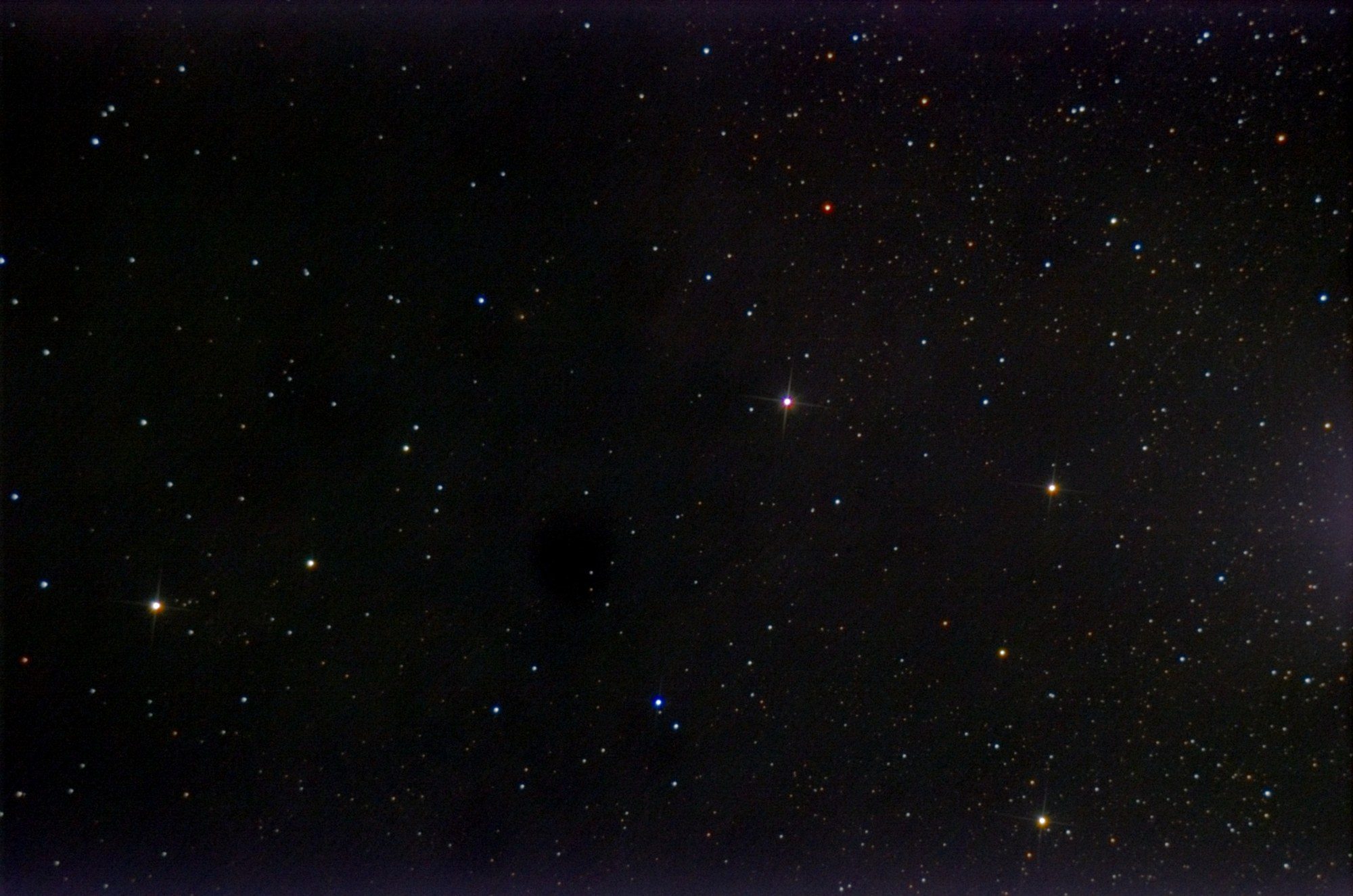
The Cygnus Wall panel. 170 frames, some of them through haze, and no sign of the nebula yet. Its glow is faint red, and from a town with no filter it will take hours, not minutes.
Claude decided the dimmed stars meant dew on the mirror. I checked with a torch and the mirror was fine. When I looked up, the sky was wispy: high haze was letting through about a fifth of the starlight.
The Triangulum Galaxy
After midnight the North America Nebula was under thick cloud, but the sky towards the Triangulum Galaxy was clear. Claude swung over to it and had it centred within a few minutes. It got 145 frames before I called it a night. The stars were sharper than earlier, and the spiral arms are there, faint, in a first stack.
Tonight’s totals
| Target | Frames kept | Exposure |
|---|---|---|
| Triangulum Galaxy, M33 | 145 | 24 min asked for, nearer 18 in fact |
| North America Nebula, Cygnus Wall panel | 170 | 28 min asked for, nearer 21 in fact |
The camera still gives about seven seconds of every ten asked for, which is why the real figures are lower.