First light: the Ring and the Dumbbell
The telescope's first evening out, a knock against its own handset, and two planetary nebulae before midnight.
Dumbbell Nebula (M27), from 22:58
- Target
- Dumbbell Nebula (M27)
- Night
- 3 October: 22:58 to 23:29
- Exposure
- 1 s each, gain 1,500
- Frames
- 82 kept of 200Left out: 104 cloud; 14 left out when stacked
- Integration
- 1 min 22 s
- Star size FWHM
- 5.56 px median per frame (half of frames 5.26 to 5.84)
- Software
- telescopeyoke v0.1.0 (676f7e3)
- Polar alignment
- About 9° out, measured from the Andromeda framesnoted
The night, frame by frame
| From | Frames | Kept | Star size, px (median of kept) | Sky background |
|---|---|---|---|---|
| 22:58 | 98 | 63 | 5.61 | 182 |
| 23:13 | 96 | 17 | 5.29 | 190 |
| 23:28 | 6 | 2 | 5.64 | 191 |
Where these numbers come from
Imported from telescopeyoke's session folder frames/M27/20261003-225840 on 2026-10-17. Values marked logged are read from these files and nothing else:
frames.jsonsha256 c5fca20074d3fdb8…restack.jsonsha256 2a45230128e53526…final.jpgsha256 17b8d91627389575…
Frame counts and integration are telescopeyoke's restack record; the reasons are its own words for each frame it left out, grouped. Depth and sky brightness are from its photometry of the stack (depth.json). Times are local, start of the first frame to end of the last.
Andromeda Galaxy (M31), from 00:56
- Target
- Andromeda Galaxy (M31)
- Night
- 3 October: 00:56 to 01:44
- Exposure
- 1 s each, gain 1,500
- Frames
- 165 kept of 200Left out: 34 left out when stacked; 1 cloud
- Integration
- 2 min 45 s
- Star size FWHM
- 6.42 px median per frame (half of frames 6.29 to 6.51)
- Software
- telescopeyoke v0.1.0 (2ef2f22)
The night, frame by frame
| From | Frames | Kept | Star size, px (median of kept) | Sky background |
|---|---|---|---|---|
| 00:56 | 74 | 60 | 6.51 | 234 |
| 01:11 | 53 | 44 | 6.30 | 234 |
| 01:26 | 63 | 51 | 6.42 | 229 |
| 01:41 | 10 | 10 | 6.37 | 232 |
Where these numbers come from
Imported from telescopeyoke's session folder frames/M31/20261004-005549 on 2026-10-17. Values marked logged are read from these files and nothing else:
session.jsonsha256 e73a209dc5a5bfe5…frames.jsonsha256 411346a7055a3cda…restack.jsonsha256 3ad316320778d508…final.jpgsha256 1a6a914497e0e8da…
Frame counts and integration are telescopeyoke's restack record; the reasons are its own words for each frame it left out, grouped. Depth and sky brightness are from its photometry of the stack (depth.json). Times are local, start of the first frame to end of the last.
Andromeda Galaxy (M31), from 01:55
- Target
- Andromeda Galaxy (M31)
- Night
- 3 October: 01:55 to 02:11
- Exposure
- 1 s each, gain 1,500
- Frames
- 46 kept of 75Left out: 21 cloud; 8 left out when stacked
- Integration
- 46 s
- Star size FWHM
- 6.27 px median per frame (half of frames 6.13 to 6.43); 9.23″ across in the stack
- Sky brightness
- 16.67 magnitudes per square arcsecond
- Depth
- stars to magnitude 16.05σ limit on open sky, inferred, Gaia G (camera unfiltered) band; 916 stars detected
- Plate scale
- 1.32″ a pixel
- Software
- telescopeyoke v0.1.0 (cc75e68)
The night, frame by frame
| From | Frames | Kept | Star size, px (median of kept) | Sky background |
|---|---|---|---|---|
| 01:55 | 68 | 46 | 6.27 | 235 |
| 02:10 | 7 | 0 | none kept | 315 |
Where these numbers come from
Imported from telescopeyoke's session folder frames/M31/20261004-015524 on 2026-10-17. Values marked logged are read from these files and nothing else:
session.jsonsha256 fdbeba6ae0dd220a…frames.jsonsha256 c788b30066168013…restack.jsonsha256 5b064540140663ee…depth.jsonsha256 c91844b58f81f59d…final.jpgsha256 ae96dda78c211fa4…
Frame counts and integration are telescopeyoke's restack record; the reasons are its own words for each frame it left out, grouped. Depth and sky brightness are from its photometry of the stack (depth.json). Times are local, start of the first frame to end of the last.
The telescope came home today: a Sky-Watcher 150P on an EQ3 Pro GoTo mount. A friend has lent me a camera, an Altair Hypercam 183C, and the plan is for a laptop beside the tripod to do the driving.
A knock before dark
The first move outdoors went wrong. With the camera fitted, a slew that swung the tube over the pole caught on something and I pulled the power.
The handset was clipped to the wrong tripod leg and the tube had hit it. Nothing was damaged. I moved the handset, set the mount back to its home position by hand and started again.
Two things came out of it:
- Limits in the software. It now refuses to go more than 5.75 hours from the meridian or below 20° altitude.
- A quirk of the handset. It answers the computer while still sitting on its start-up screen, before it has read the mount’s gearing, and then the mount turns much further than the handset says. It has to be at its main menu before anything is sent.
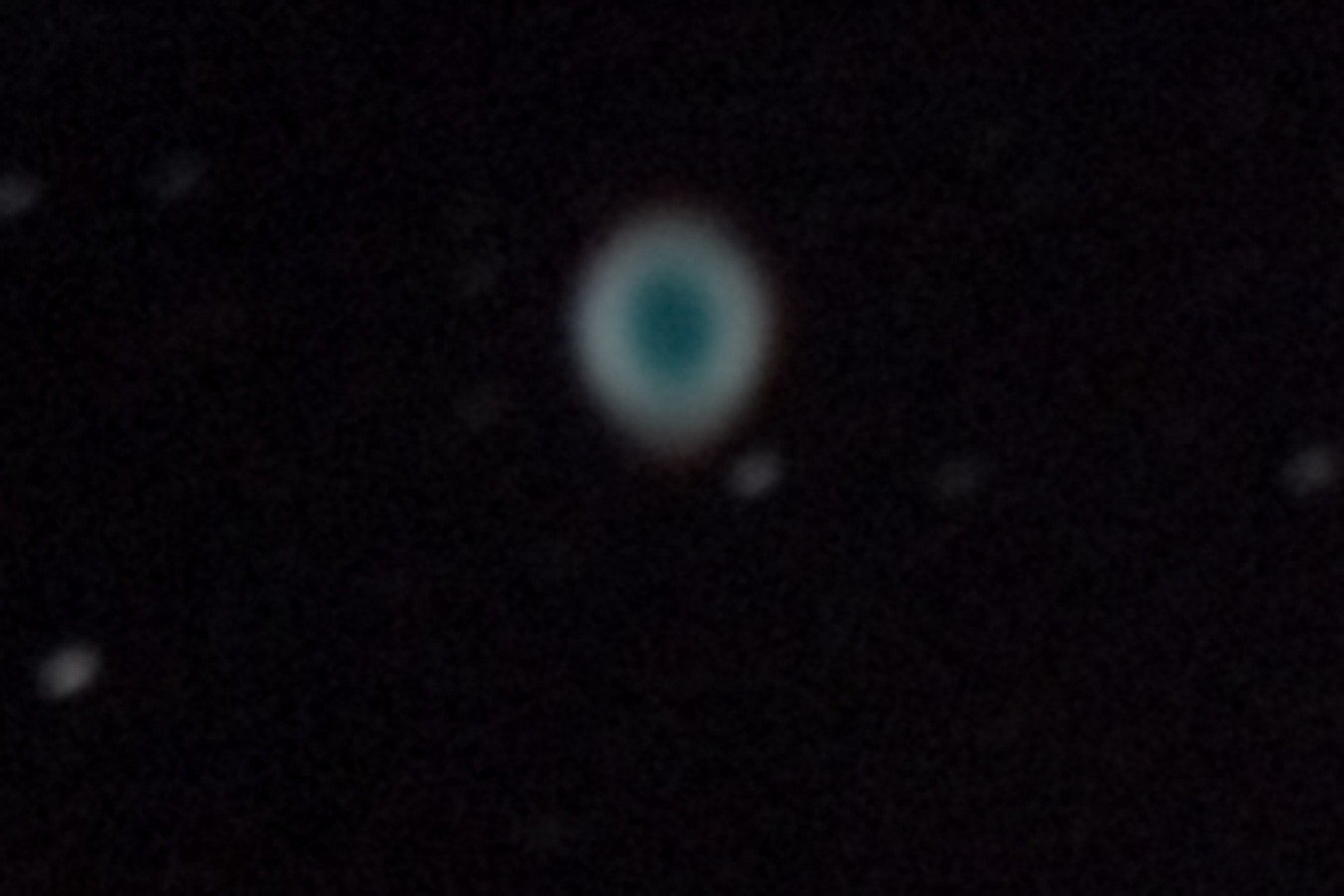
The Ring Nebula, M57
M57, cropped hard from the full frame.
The first proper target. It is tiny in a telescope this size, but the ring and its darker middle are plainly there, and so is the colour.
The Dumbbell Nebula, M27
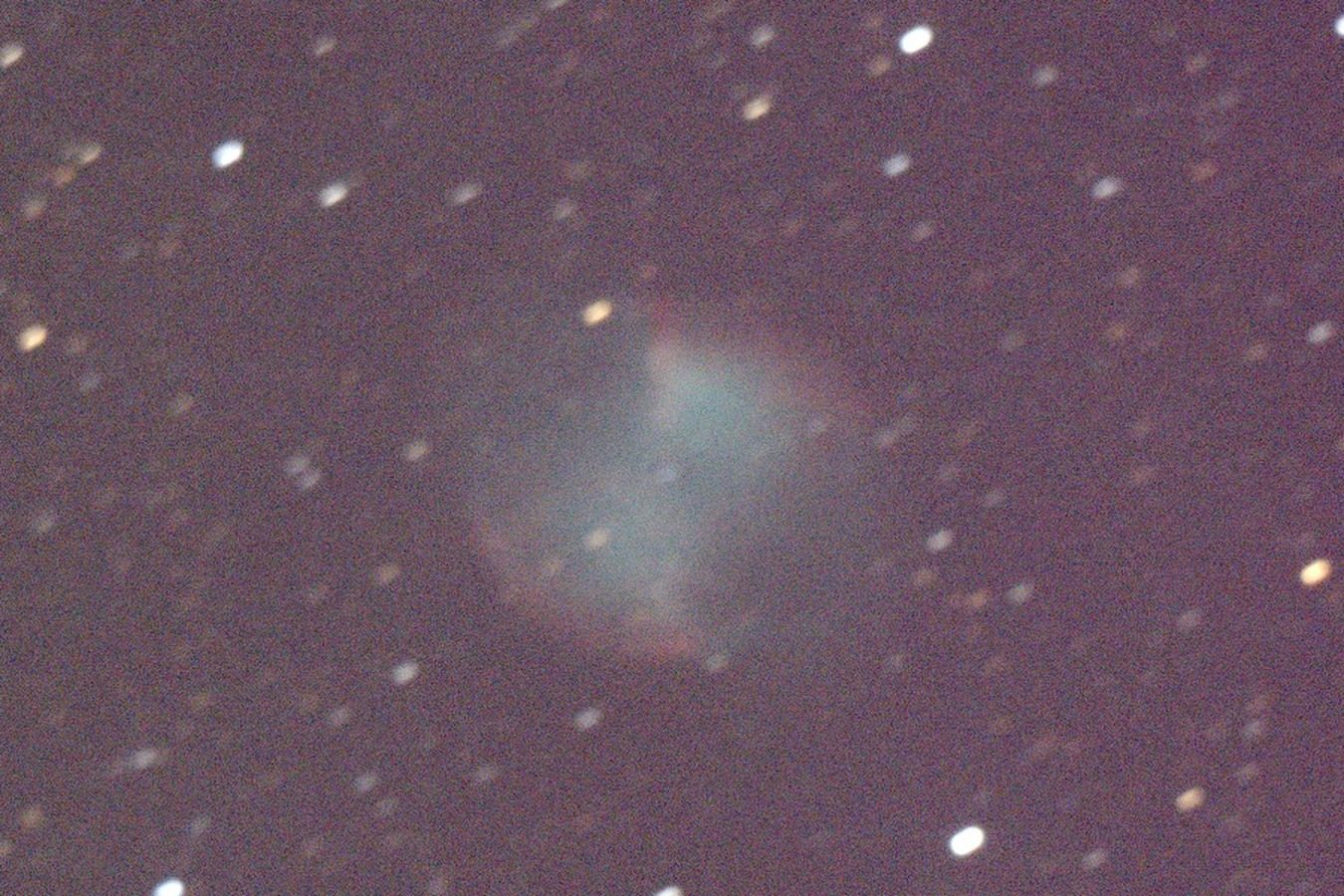
M27, cropped close from the night’s stack: the hourglass shape that gives it its name.
Much fainter in my picture than the Ring, and only just showing. Focus had been set earlier on a nearby tree, and the stars show it. Something to come back to with longer exposures and better focus.
After midnight the Andromeda Galaxy followed, in two runs cut short by cloud: 207 one-second frames in all, enough to show its dust lanes. Measured from those frames, the mount’s polar axis was about 9° out that night.