The Monkey Head in colour
20 to 21 November: the first colour nebula from the mono camera, NGC 2174 in Ha, OIII and SII. The focuser's slack fell from 156 half-steps to 32, the declination fault was pinned down, and the dew shields had their first night out.
20 November, 18:21, to 21 November, dawn, a back garden in Northern Ireland.
The focuser
I tightened the four screws holding the focuser’s wheel to its barrel and adjusted the tension screw before going out. The slack measured 16 and 32 half-steps at the two reversals, against 156 the night before. Focus then held well enough to run through three filters, each with its own measured offset.
Declination, pinned down
The guiding trouble since the service now has a clear description. East of the meridian the Dec motor moves the tube north, sticking and then jumping 20 to 50 arcseconds, and doesn’t move it south at all. West of the meridian it barely moves either way: 403 arcseconds of pulses each way moved the tube 11 south and 17 north. Guiding can’t hide that, so until the drive is fixed I’m guiding in RA only and keeping frames to two minutes.
Between the clouds
Cloud came and went until about 23:30. IC 405, the Flaming Star, got another 40 minutes of Ha before the guide star was lost at 00:36. Then it was on to NGC 2174 for the rest of the night: 40 minutes of Ha, 80 of OIII and 58 of SII. A re-centre during OIII swung the tube across the meridian and the guider kept its old calibration, which stopped the run until it was fixed. Three guide-star losses over the night still have no settled cause.
No dew
The night before, the tube dewed up by 03:41. This time, with the new dew shields on, star sizes stayed steady at about 6 pixels until 06:00, on a night the forecast model had even closer to the dew point. That’s one night and a model’s figures, so the shields are the likely reason rather than a proven one.
Colour
Dawn flats went well in all seven filters, including the first for SII. The daylight skyline survey I’d asked for didn’t happen: Claude put it off until later in the morning without telling me, and by then I’d packed up.
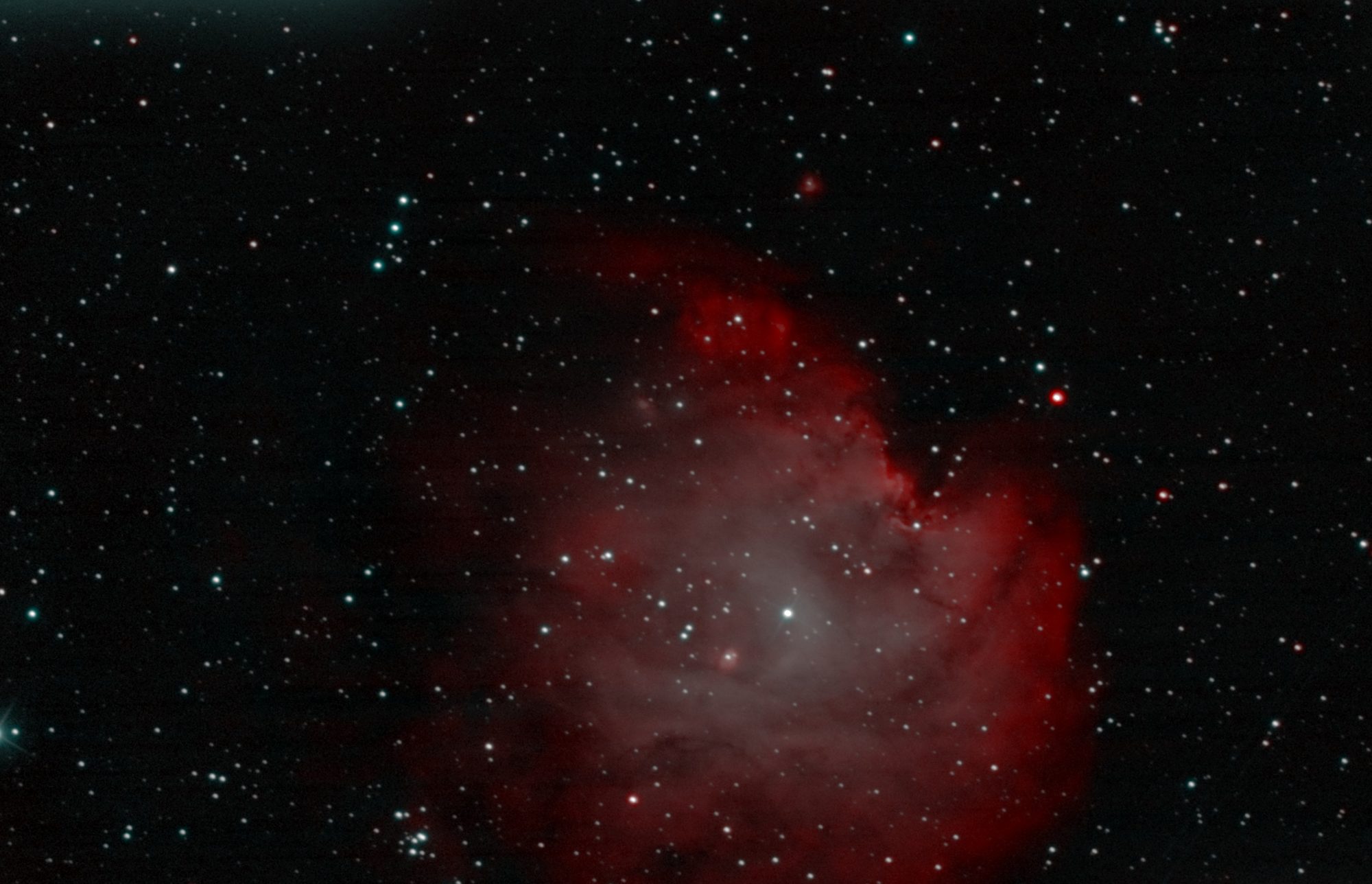
The next day, with the scope indoors in its bag taking darks, the three stacks became the first colour nebula from this camera. Ha and OIII give the red nebula with its paler centre above. The Hubble palette, with SII as red, Ha as green and OIII as blue, gives a blue core with gold edges.
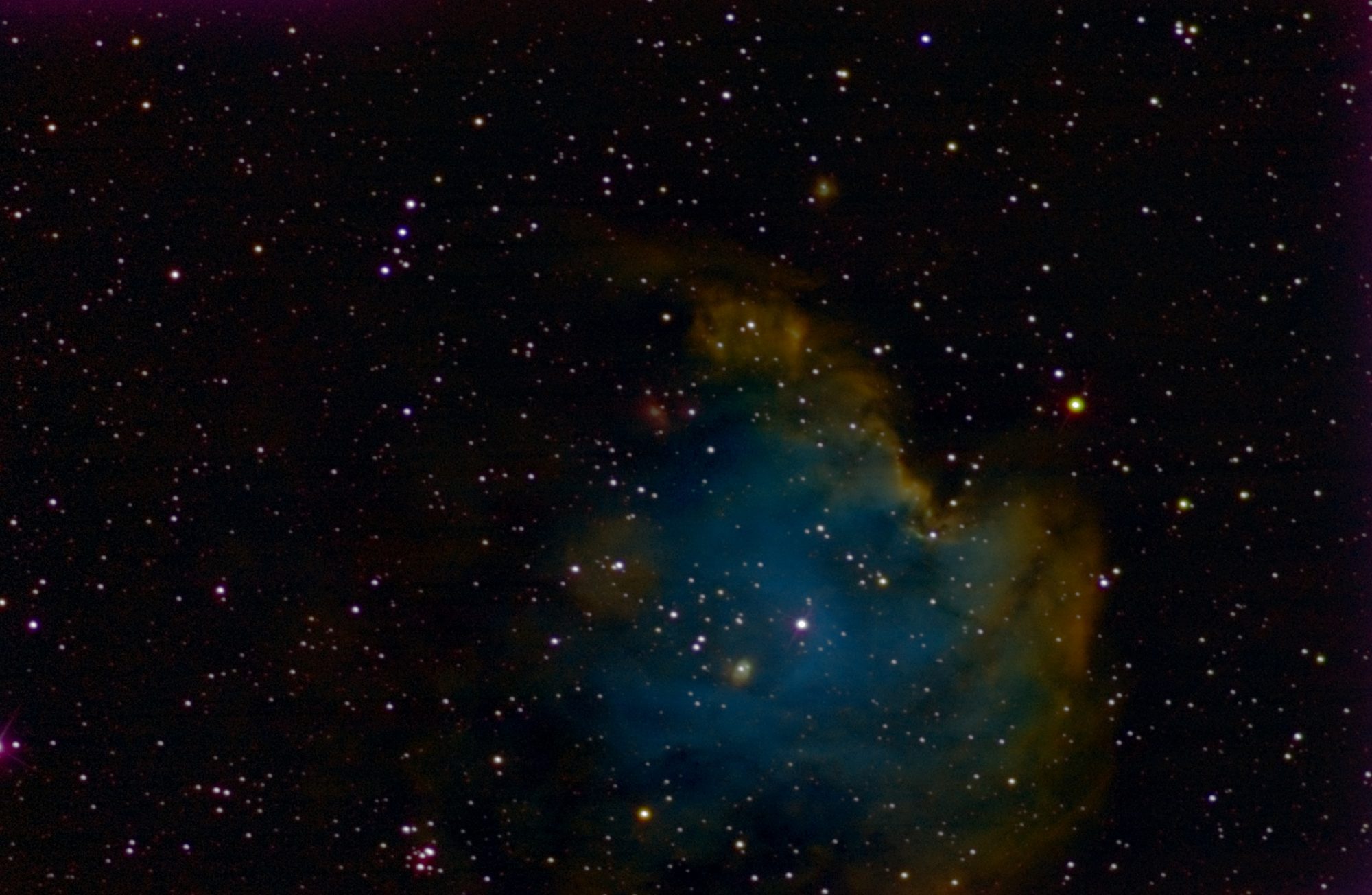
The colour used 40 minutes of Ha, 74 of OIII and 48 of SII. The focuser working, the declination fault identified and no dew made it a fairly successful evening, and I went to bed with a smile.