The Flaming Star, and a mount that only goes one way
The night of 19 to 20 November: the clearest sky I've seen, the first long guided frames since the mount was serviced, the Flaming Star and the Monkey Head in hydrogen-alpha, and a long hunt for why the mount's declination axis won't follow the guider, which ended with it moving one way and not the other. Dew finished the night at three.
Shot 19 to 20 November, between 17:00 and 03:40, a back garden in Northern Ireland.
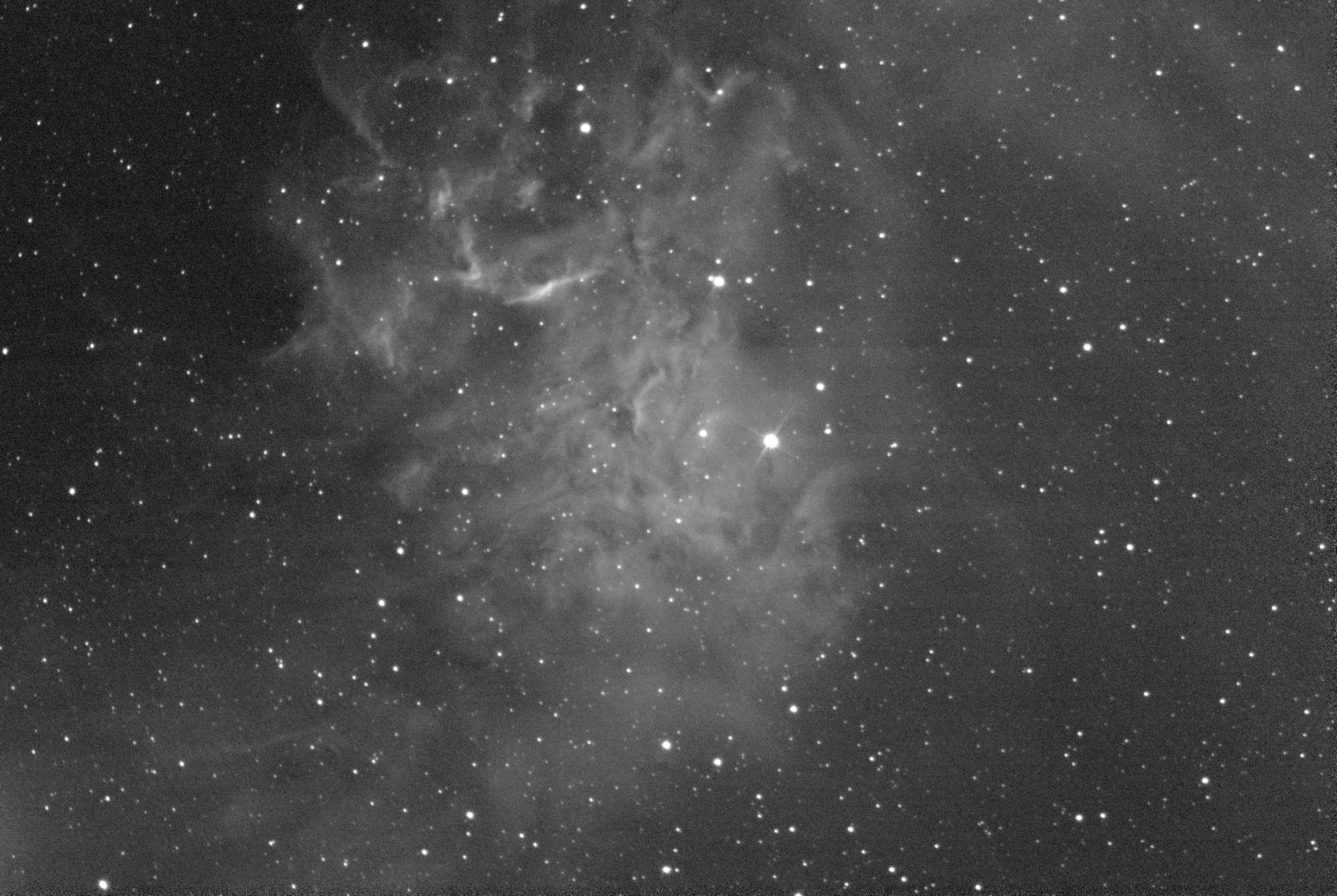
The Flaming Star Nebula (IC 405) in hydrogen-alpha, from the guided two-minute frames.
A slow start
The sky was as clear as I’ve ever seen it. The cooled camera took six goes to get cold. The first time, its 12 V lead wasn’t plugged in, and when it went in with the cooler already running, the cooler ran away below its target. I was quite annoyed. After a USB unplug it cooled properly and held -5 °C from about twenty past five for the rest of the night.
Focus, properly this time
The new motor focuser had its first real night of work. It focused in every filter on the Double Cluster, all seven within a few steps of each other. Moving between filters showed the drawtube slipping a little on every round trip, so I tightened the hidden tension screw a quarter turn, then too far, then backed it off. It now loses about half what it did. The old “walk-in” focusing is gone: the motor focuses from wherever it is, in small steps, either way.
The declination axis
Since the mount was serviced, the guider hasn’t been able to move the declination axis. Most of the night went on finding out why.
The guide lead and the mount’s motor board turned out to be fine: they count every step at exactly the right rate. The tube didn’t follow. Part of it was the declination clutch, which was far too loose. The tube moved when I fitted a hot water bottle to the dewed-up guide scope, so I tightened it a lot, and the slipping stopped.
With the clutch tight, the guider passed its calibration for the first time since the service. It guided right ascension well enough for round stars in two-minute frames, the first long guided frames since the service.
Declination still wouldn’t follow reliably. Claude wrote a proper test: push north until the star really moves, rest, push again, then reverse. With the hot water bottle and the balance sand on, north never moved. With them off, north moved and south didn’t move at all, through 14 arcminutes of pushing. Which way it fails flipped when the balance changed. That isn’t ordinary backlash. Something lets go under an out-of-balance load. That goes to the friend who serviced it, with all the logs, and we’ll check the balance properly in daylight.
The GoTos that went wrong all night were all on the west side near the meridian, with the tube near vertical. I think it’s catching the tripod leg there, so I lowered the scope. The next GoTo lower on that side went cleanly.
The pictures
The Flaming Star in hydrogen-alpha: 43 sixteen-second frames unguided and 12 two-minute frames guided, about 35 minutes in all. Then the Monkey Head Nebula, about 20 minutes of sixteen-second frames through passing cloud. It sits on the right of the frame, so it needs another night and better framing.
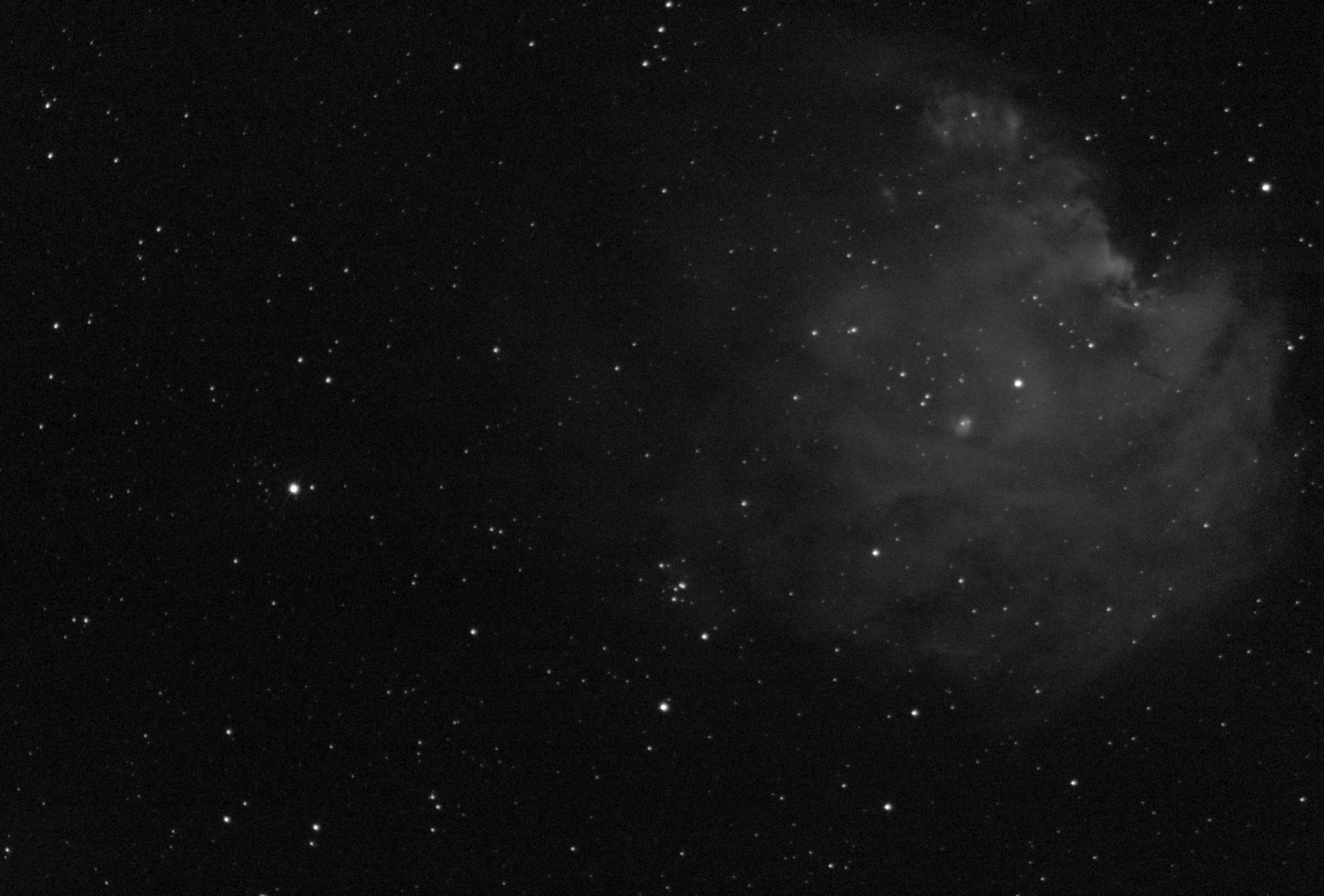
The Monkey Head Nebula (NGC 2174) in hydrogen-alpha, about 20 minutes of sixteen-second frames.
Dew
The guide scope dewed twice. A hot water bottle and a card dew shield held it for a while, and a proper dew heater strip is on its way. At about three the main telescope’s mirror dewed over too: stars came out nine times too big with the focus where it had been sharp. I called it a night, the telescope parked itself home, and the camera warmed up slowly. No flats this time: flats through a dewed mirror wouldn’t match the frames. A dew shield for the main tube is on the list for the daytime.