A pleasant surprise
21 to 22 November: a night I didn't expect to get, under a 90% Moon. The Flaming Star in Ha and SII, and the first readings of Tabby's star in four filters on the mono camera, until the overcast arrived at 02:20.
21 November, 18:40, to 22 November, 02:45, a back garden in Northern Ireland.
Worth setting up?
The sky looked pretty clear in the evening, so I carried everything out. With my polar alignment markers on the ground, the mount came up 0.2° from the pole and needed no adjusting. Motor focus went from badly out to sharp without me touching it, and collimation read 6% off centre, against 14% the night before.
Tabby’s star in four filters
Tabby’s star came first, a few minutes each in L, B, R and G. These are the first readings of it through each filter on the mono camera:
- L: 11.879 ± 0.011
- B: 11.832 ± 0.040
- R: 11.804 ± 0.019
- G: 11.880 ± 0.014
They’re all on Gaia’s G scale, so they can’t be read as the star’s true colour. Each filter needs three nights before a dip or a colour change can be judged, so this is night one of three.
The filter wheel stopped answering at 19:58 as it turned to G. Claude tried resetting its USB port, which knocked it off USB altogether, so I replugged it and the queue carried on five minutes later.
The Flaming Star
IC 405 then had the rest of the night, in two-minute frames with guiding in RA only until the declination drive is fixed. The dew shield fell off the main scope at about 21:10. I put it back, the run lost one frame and the guide star, and it restarted itself three minutes later.
The sky brightness kept swinging from frame to frame, so we tested the kitchen light: a few frames with it off, then a few with it on. The sky came up 9% and the stars dropped 3%, which is within the frames’ normal scatter and close to what we measured in October. The bigger swings carried on with the light off, and I still don’t know what caused them.
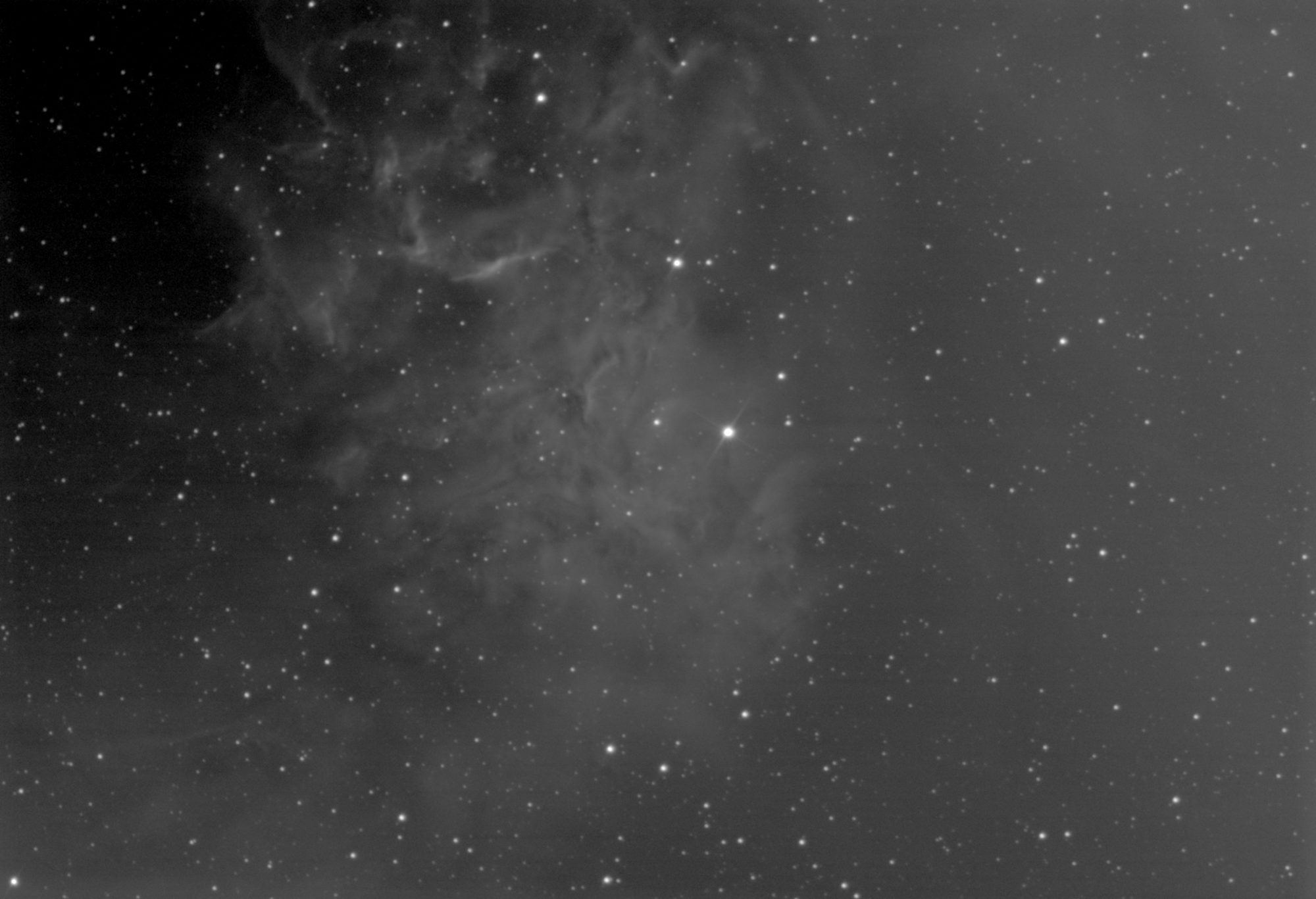
At about 00:15 I asked for a second filter on it rather than more of the same. By the end there were 152 minutes of Ha and 78 of SII. The picture above is the Ha from this night and the two before it, 89 frames and just under three hours. SII is much fainter here, and its 58 stacked minutes show only the brightest edges so far.
Calling it
Overcast reached us at 02:20, just as the scope moved to the Monkey Head, which got nothing. Every filter now has a first measured depth, though they came from different fields and skies, so they can’t be ranked yet.
I hadn’t expected to get anything, so I wasn’t going to push my luck. I parked it at 02:31 and skipped the dawn flats, since the ones from the day before will do, and brought the scope in.