The mineral Moon
The colour Moon from the night of 29 to 30 October, finished: three videos, 2,513 frames taken and the sharpest 1,005 combined, the Moon's faint real colour turned up fifteen times, and checked against the spacecraft maps.
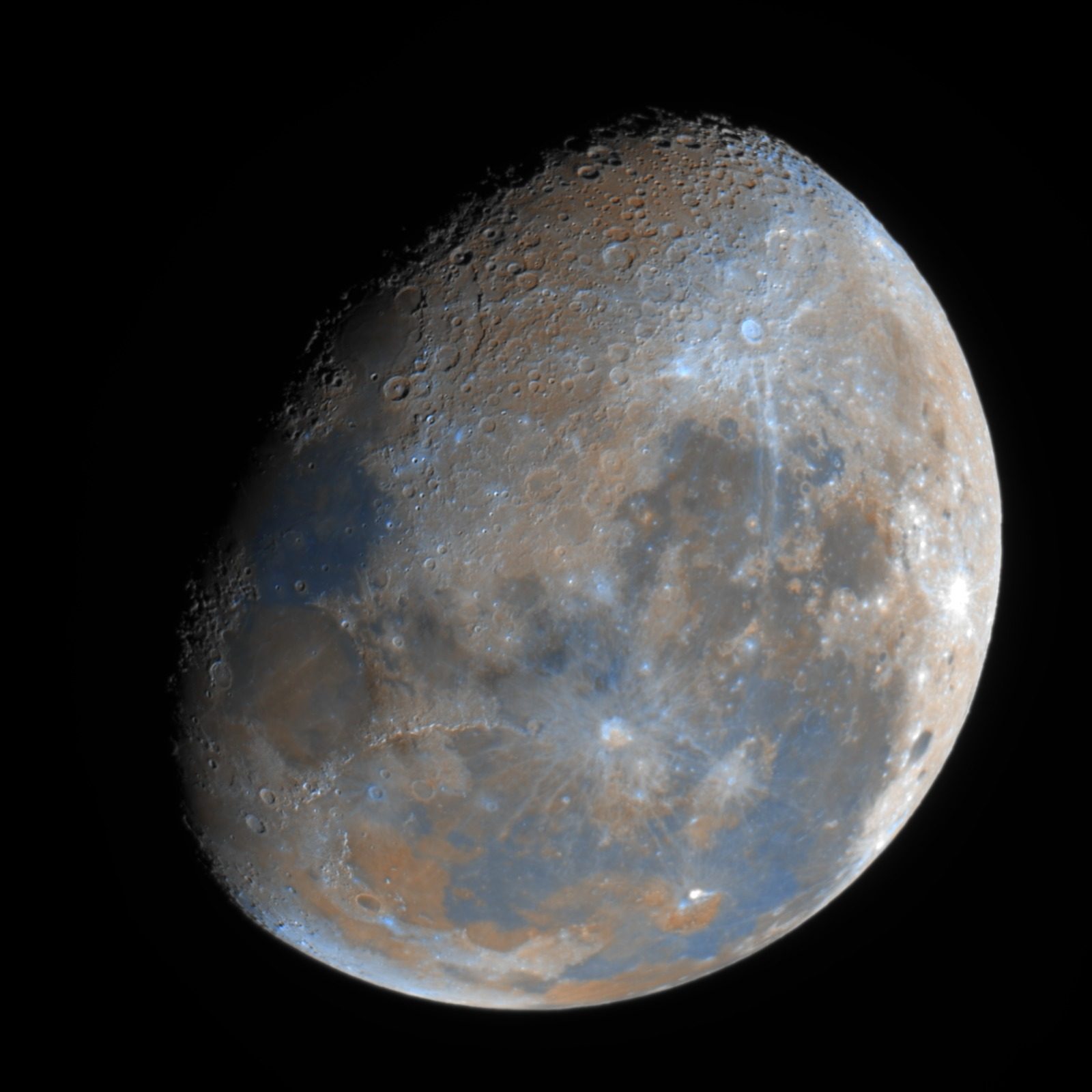
Shot 30 October, between 01:55 and 02:30, a back garden in Northern Ireland.
What the colours are
The Moon isn’t quite grey. Its colours are faint, a percent or two either way, but they’re real. Spacecraft maps, made through narrow filters, show many of the bluer seas as lava rich in titanium, and freshly dug-up ground, like the rays thrown out by young craters, as bluer than old weathered ground. A colour camera like this one can pick up some of those differences, so the colours here go with what the ground is made of and how long it has lain in the sunlight. They don’t measure it: the camera’s three filters are too broad to say how much titanium or iron is there. This picture has the colour turned up 15 times.
One check is possible, though. The spacecraft maps say Mare Tranquillitatis is bluer than its round neighbour Mare Serenitatis, and bluer than the bright uplands. Claude worked out which way the picture lies on the Moon from the terminator and the seas (south is at the top, as a Newtonian telescope shows it) and measured both. Tranquillitatis came out bluer than Serenitatis by 2%, and bluer than the uplands by 2.3%, the same way round in every video. In the picture, it’s the blue sea on the left, halfway down; Serenitatis is the round brown one just below it. Which way the picture lies was checked another way too: a star field photographed later that night with the same camera gave the same angle to within a tenth of a degree. Across the whole Moon, though, the colours only loosely follow Clementine’s full colour map so far, which is what the next colour night is for.
How it was made
It’s three videos from the colour Moon night, 2,513 frames in all. Each video was stacked from its sharpest frames, part by part, so every bit of the surface comes from the moments the air held still there. The detail comes from those sharp stacks. The colour comes from the best 40% of every video, because colour needs lots of frames more than it needs sharpness.
Getting the colour honest took a few goes:
- Green first. The camera’s green pixels take in more light than its red and blue, so the plain stacks came out green. Balanced so the surface averages grey, they look like the Moon.
- One video too bright. The first video was overexposed, and its brightest craters were flattened at the top. Turned up, that showed as false colour, so where any video was too bright, the others fill in.
- A slope across the disc. Red rose about 2% from one edge of the Moon to the other, the same in every video. That’s five times the colour of the minerals, so it comes off before anything is turned up.
- Only blue against orange. The camera also adds a green-against-magenta tint of its own. The Moon’s colour shows mostly from blue to orange, so that’s the only colour kept in this picture.
- Only colour that repeats. Each video’s colour is compared with the others’, and colour that doesn’t turn up in all of them is turned down.
Next time the colour comes from videos taken for it: the camera’s full 12 bits rather than 8, exposed so nothing clips, with the Moon moved across the sensor between them so the camera’s own patterns can’t repeat.
The night before
How the videos were taken, between the clouds, is in A colour Moon between the clouds.