A night in the fog
The night of 2 to 3 November: fog rolled in an hour after dark and stayed, and the telescope kept working through it. Nova searches of Andromeda, Triangulum and M81/M82 found nothing new, NGC 7331 got its first reference picture, and an exoplanet transit was recorded but lost to the fog.
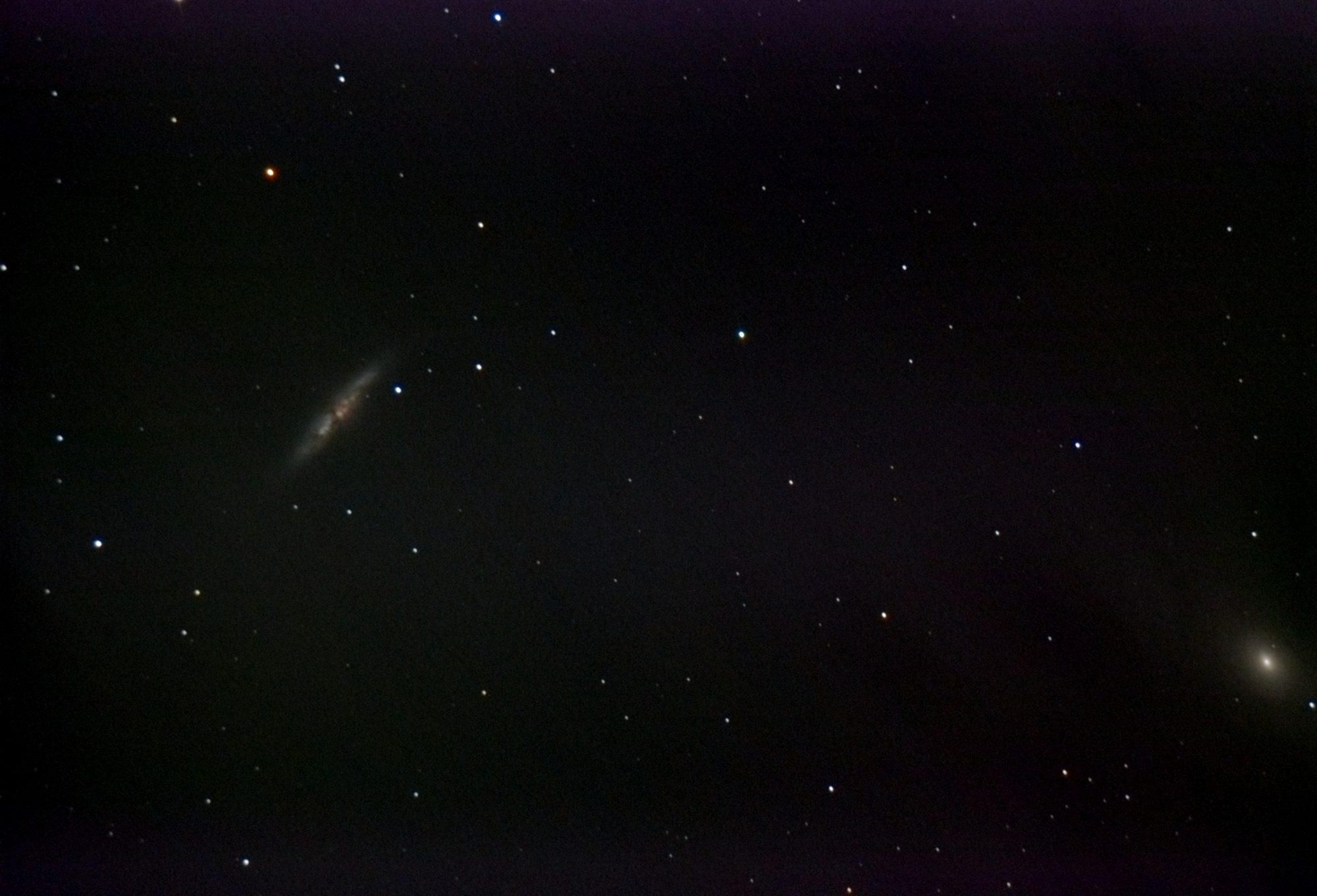
Shot 2 to 3 November, between 19:00 and 09:45, a back garden in Northern Ireland.
The Cigar Galaxy (M82, left) and Bode’s Galaxy (M81, lower right), 41 minutes of 16-second frames taken between 3 and 4 in the morning, through fog.
The fog
The forecast said cloudy with dew. What came was fog. About 20:45 a friend half a mile away, lower down than me, messaged to say they could see nothing and could barely make out M33 on his screen. It reached the house soon after, sitting just above the roofs, and from the garden I couldn’t see a single star. The telescope still could, just: the stars in each frame dropped to about a quarter of their usual number, and the run kept the frames that were good enough. By the time I’d checked, the forecast had learned about fog as well. It now looks at visibility and at still, saturated air, and it said fog all night. It was right.
The picture above is the surprise of the night. By the time M81 and M82 came round, the sky was letting through less than a fifth of the light it did the night before, and the galaxies still came out, with the dust lane across the Cigar.
The searches
Andromeda, Triangulum and M81/M82 were each searched for a nova, a star that wasn’t there in the reference picture. None of them had one. The fog cost depth: Andromeda’s search reached magnitude 16 instead of the usual 17.4. A night that finds nothing still counts, because it says nothing new was there to the depth it could see.
NGC 7331 was a new field, taken because a supernova, SN 2026aaiv, was reported in it. This first night’s picture becomes the reference that later nights are compared against.
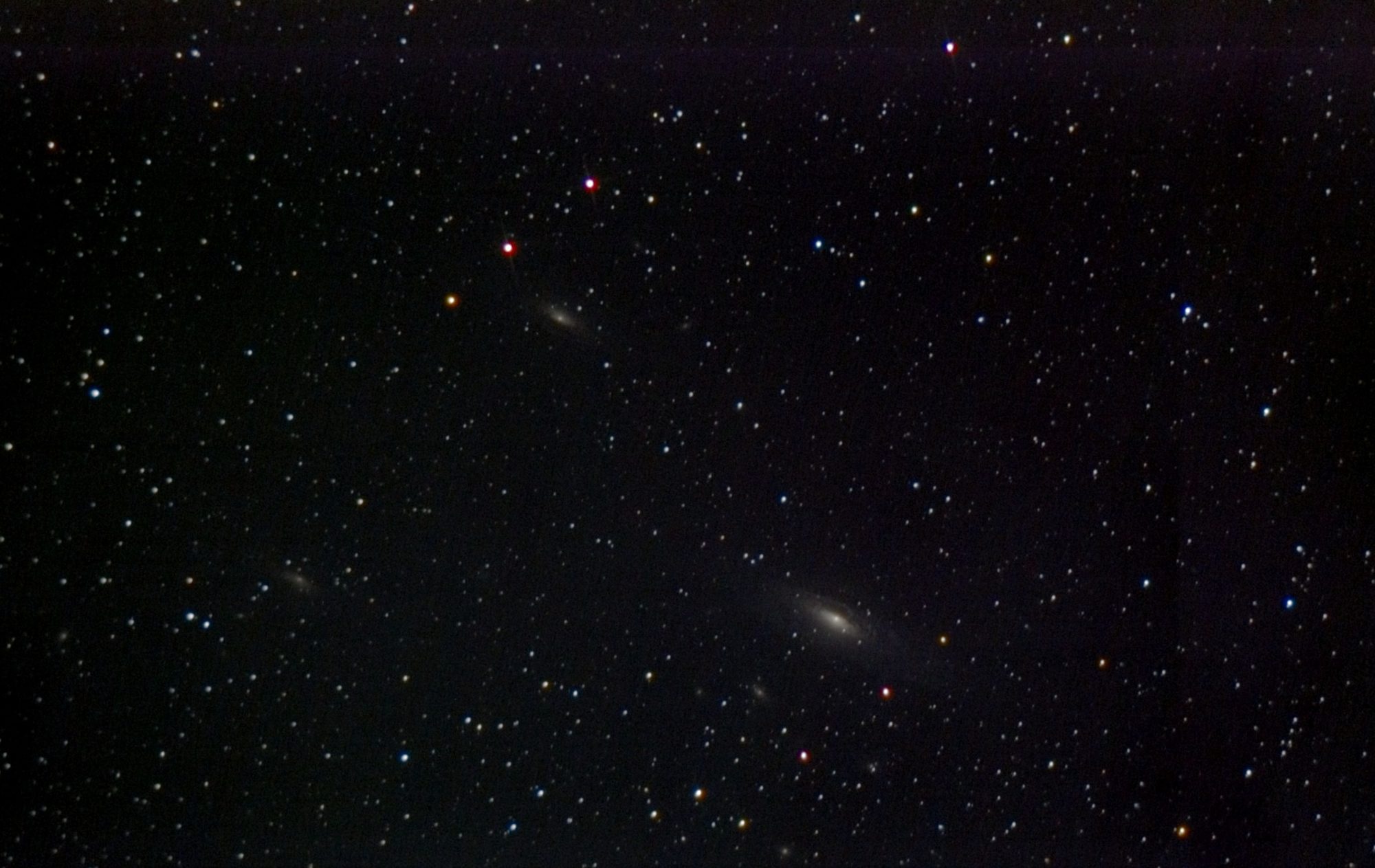
NGC 7331 (lower right), with smaller galaxies around it, 21 minutes of 16-second frames.
The transit
The main event was meant to be Qatar-5 b, a planet that crosses in front of its star and dims it by about 1%, for almost three hours. The telescope stayed on the star from 22:18 until it went behind the house around 02:50, with a short break when the fog got so thick that the run stopped itself. Over 1,400 frames were kept. But the fog made the star flicker by six or seven times more than the dip I was looking for, so there’s no timing to send. I’m surprised there’s anything at all.
What changed
- The YouTube stream had shown nothing for four nights in a row, because every broadcast had ended and nothing opened a new one. The stream now opens its own broadcast before it starts sending.
- Stacking and searching used to keep the telescope waiting after each run. Now they happen in the background and the telescope goes straight to the next target.
- After the telescope crossed the meridian, it kept re-centring every few minutes. The frames had turned half round, and it took that for drift. It now measures drift from the first frame after each centring.
- The mount’s declination gears have some slack in them, which defeated the routine that holds a star still. That routine now learns the slack and takes it up each time it changes direction.
The next morning, once the twilight flat was done, the telescope traced the skyline by daylight from its marked spot and then parked itself.